Kapitza H G, Rüppel D A, Galla H J, Sackmann E
Biophys J. 1984 Mar;45(3):577-87. doi: 10.1016/S0006-3495(84)84195-8.
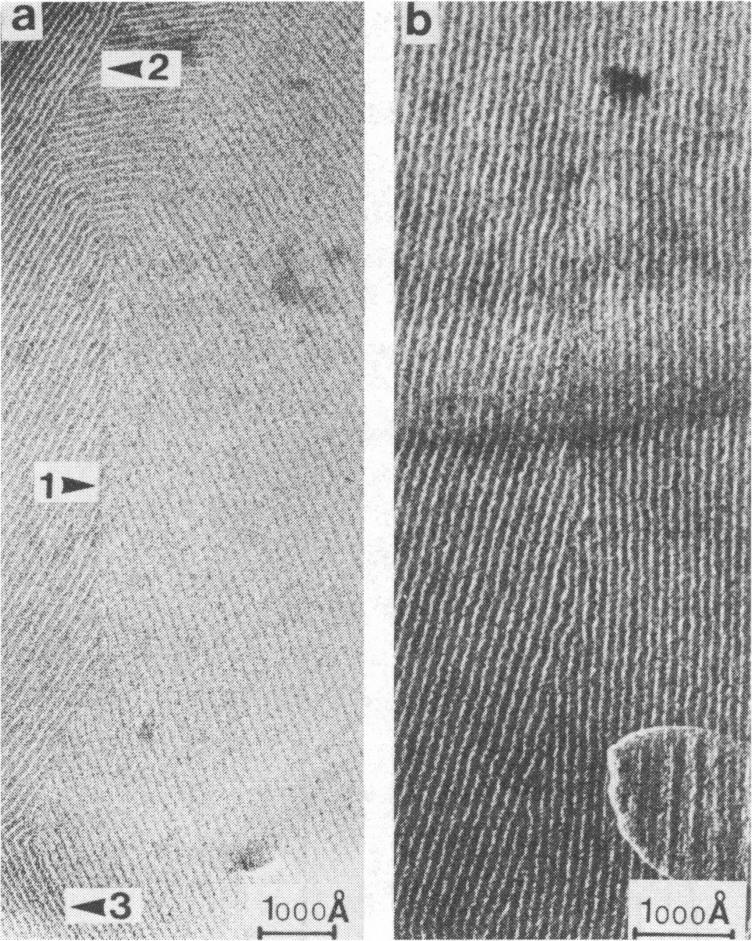
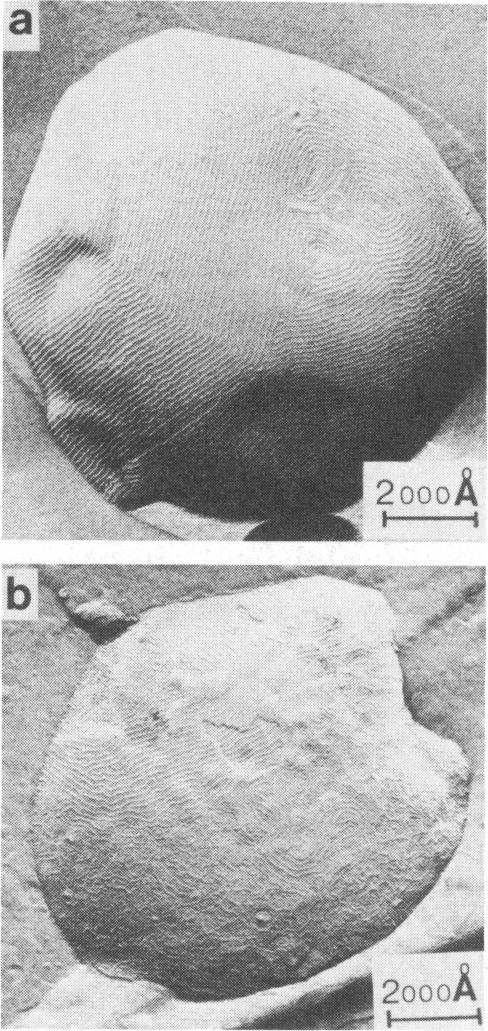
The lateral mobility of the lipid analog N-4-nitrobenzo-2-oxa-1,3 diazole phosphatidylethanolamine and of the integral protein glycophorin in giant dimyristoylphosphatidylcholine vesicles was studied by the photobleaching technique. Above the temperature of the chain-melting transition (Tm = 23 degrees C), the diffusion coefficient, Dp, of the protein [Dp = (4 +/- 2) X 10(-8) cm2/s at 30 degrees C] was within the experimental errors equal to the corresponding values DL of the lipid analog. In the P beta 1 phase the diffusion of lipid and glycophorin was studied as a function of the probe and the protein concentration. (a) At low lipid-probe content (cL less than 5 mmol/mol of total lipid), approximately 20% of the probe diffuses fast (D approximately equal to 10(-8) - 10(-9) cm2/s), while the mobility of the rest is strongly reduced (D less than 10(-10) cm2/s). At a higher concentration (cp approximately 20 mmol), all probe is immobilized (D less than 10(-10) cm2/s). (b) Incorporation of glycophorin up to cp = 0.4 mmol/mol of total lipid leads to a gradual increase of the fraction of mobile lipid probe due to the lateral-phase separation into a pure P beta 1 phase and a fraction of lipid that is fluidized by strong hydrophilic lipid-protein interaction. (c) The diffusion of the glycophorin molecules is characterized by a slow and a fast fraction. The latter increases with increasing protein content, which is again due to the lateral-phase separation caused by the hydrophilic lipid-protein interaction. The results are interpreted in terms of a fast transport along linear defects in the P beta 1 phase, which form quasi-fluid paths for a nearly one dimensional and thus very effective transport. Evidence for this interpretation of the diffusion measurements is provided by freeze-fracture electron microscopy.
采用光漂白技术研究了脂质类似物N - 4 - 硝基苯并 - 2 - 恶唑 - 1,3 - 二氮杂环戊二烯磷脂酰乙醇胺以及整合蛋白血型糖蛋白在巨大二肉豆蔻酰磷脂酰胆碱囊泡中的侧向流动性。在链熔化转变温度(Tm = 23℃)以上,蛋白质的扩散系数Dp [在30℃时Dp = (4 ± 2)×10⁻⁸ cm²/s] 在实验误差范围内与脂质类似物的相应值DL相等。在Pβ1相中,研究了脂质和血型糖蛋白的扩散与探针及蛋白质浓度的函数关系。(a) 在低脂质 - 探针含量(cL小于5 mmol/mol总脂质)时,约20%的探针快速扩散(D约等于10⁻⁸ - 10⁻⁹ cm²/s),而其余部分的流动性则大幅降低(D小于10⁻¹⁰ cm²/s)。在较高浓度(cp约为20 mmol)时,所有探针均被固定(D小于10⁻¹⁰ cm²/s)。(b) 加入高达cp = 0.4 mmol/mol总脂质的血型糖蛋白会导致可移动脂质探针的比例逐渐增加,这是由于侧向相分离形成了纯Pβ1相以及一部分因强烈的亲水脂质 - 蛋白质相互作用而流化的脂质。(c) 血型糖蛋白分子的扩散具有慢速和快速两个部分。后者随蛋白质含量的增加而增加,这同样是由于亲水脂质 - 蛋白质相互作用引起的侧向相分离。结果根据Pβ1相中沿线性缺陷的快速传输来解释,这些线性缺陷形成了近乎一维的准流体路径,从而实现非常有效的传输。冷冻蚀刻电子显微镜为这种扩散测量的解释提供了证据。