Packman L C, Shaw W V
Biochem J. 1981 Feb 1;193(2):525-39. doi: 10.1042/bj1930525.
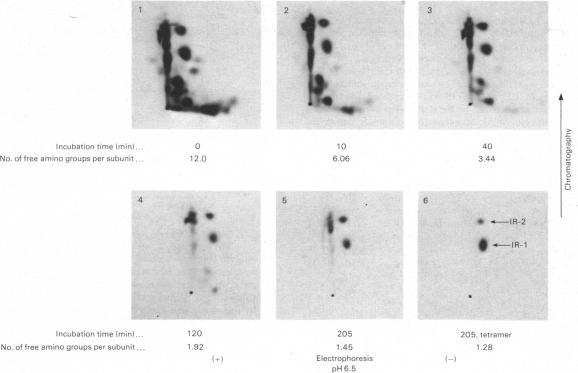
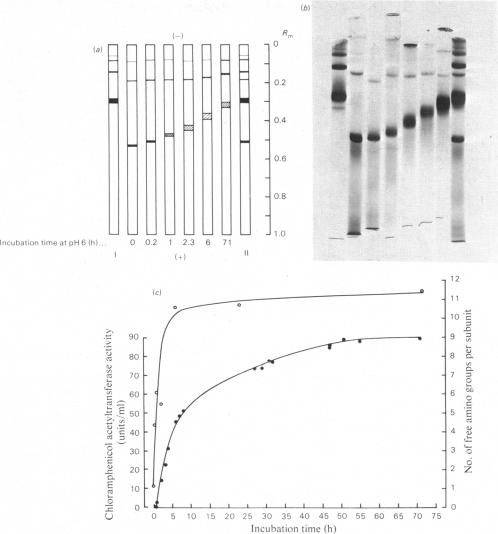
Two variants of chloramphenicol acetyltransferase which are specified by genes on plasmids found in Gram-negative bacteria were subjected to amidination with methyl acetimidate to determine the relative reactivity of surface lysine residues and to search for unreactive or "buried" amino groups which might contribute to stabilization of the native tetramers. Representative examples of the type-I and type-III variants of chloramphenicol acetyltransferase were found to have one lysine residue each in the native state which appears to be inaccessible to methyl acetimidate. The uniquely unreactive residue of the type-I protein is lysine-136, whereas the lysine that is "buried" in the type-III enzyme is provisonally assigned to residue 38 of the prototype sequence. It is suggested that the lysine residue in each case participates in the formation of an ion pair at the intersubunit interface and that the two amino groups in question occupy functionally equivalent positions in the quaternary structures of their respective enzyme variants. Lysine-136 of type-I enzyme is also uniquely unavailable for modification by citraconic anhydride, a reagent used to disrupt the quaternary structure of the native enzyme. Contrary to expectation, exhaustive citraconylation fails to dissociate the tetramer, but does destroy catalytic activity. Removal of citraconyl groups from modified chloramphenicol acetyltransferase is accompanied by a full region of catalytic activity. Analysis of the rate of hydrolysis of citraconyl groups from the modified tetramer by amidination of unblocked amino groups with methyl [14C]acetamidate reveals difference in lability for several of the ten modified lysine residues. Although the unique stability of the quaternary structure of chloramphenicol acetyltransferase may be due to strong hydrophobic interactions, it is argued that lysine-136 may contribute to stability via the formation of an ion pair at the subunit interface.
对革兰氏阴性菌中质粒上基因所编码的氯霉素乙酰转移酶的两种变体进行了用乙酸甲酯脒进行脒化处理,以确定表面赖氨酸残基的相对反应性,并寻找可能有助于天然四聚体稳定的无反应性或“埋藏”的氨基。发现氯霉素乙酰转移酶I型和III型变体的代表性实例在天然状态下各自有一个赖氨酸残基,该残基似乎无法与乙酸甲酯脒反应。I型蛋白唯一无反应性的残基是赖氨酸-136,而III型酶中“埋藏”的赖氨酸暂时指定为原型序列的第38位残基。有人提出,在每种情况下,赖氨酸残基都参与亚基间界面处离子对的形成,并且所讨论的两个氨基在各自酶变体的四级结构中占据功能等效的位置。I型酶的赖氨酸-136也不能被用于破坏天然酶四级结构的试剂柠康酸酐修饰。与预期相反,彻底的柠康酰化不能使四聚体解离,但确实会破坏催化活性。从修饰的氯霉素乙酰转移酶中去除柠康酰基伴随着催化活性的完全恢复。通过用甲基[14C]乙酰胺脒对未封闭的氨基进行脒化来分析修饰的四聚体中柠康酰基的水解速率,揭示了十个修饰的赖氨酸残基中有几个在不稳定性上的差异。虽然氯霉素乙酰转移酶四级结构的独特稳定性可能归因于强烈的疏水相互作用,但有人认为赖氨酸-136可能通过在亚基界面形成离子对来促进稳定性。