Crosby I K, Wellons H A, Taylor G J, Maffeo C J, Beller G A, Muller W H
Ann Surg. 1981 Jun;193(6):743-51. doi: 10.1097/00000658-198106000-00009.
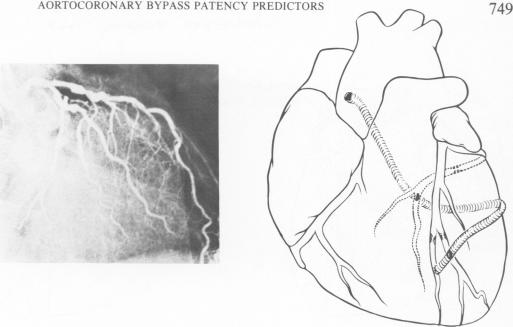
A prospective analysis of the angiographic and operative anatomic and reconstructive variables that influenced graft patency was undertaken at the University of Virginia Medical Center in 50 consecutive patients. Postoperative restudy showed that 18 of the 168 grafts performed were occluded due to venous disease, inadequate run-off, or sequential design error. Angiographic artery size was 27% larger than operative estimations; graft patency significantly increased with increasing distal artery diameter, with decreasing venous conduit diameter, and with good graftability rating of the vessels preoperatively. Ejection fraction, the degree of arterial stenosis, and the source of the saphenous vein conduit (the thigh or the lower leg) had no influence on graft patency. Simple grafts had a 96% patency, while sequential grafts had an 80% patency. When design error for sequential grafts was eliminated, the sequential patency rate rose to 88%. For revascularization of small circumflex vessels, consideration should be given to variation in the sequential grafting technique to improve patency in these vessels.
弗吉尼亚大学医学中心对50例连续患者进行了一项前瞻性分析,研究影响移植物通畅性的血管造影、手术解剖及重建变量。术后复查显示,所施行的168例移植物中有18例因静脉疾病、流出道不足或序贯设计错误而闭塞。血管造影显示的动脉大小比手术估计值大27%;随着远端动脉直径增加、静脉导管直径减小以及术前血管的良好移植性评级,移植物通畅性显著提高。射血分数、动脉狭窄程度以及大隐静脉导管的来源(大腿或小腿)对移植物通畅性无影响。单纯移植物的通畅率为96%,而序贯移植物的通畅率为80%。当消除序贯移植物的设计错误时,序贯通畅率升至88%。对于小回旋支血管的血运重建,应考虑序贯移植技术的变化以提高这些血管的通畅性。