Scott J E
Biochem J. 1980 Jun 1;187(3):887-91. doi: 10.1042/bj1870887.
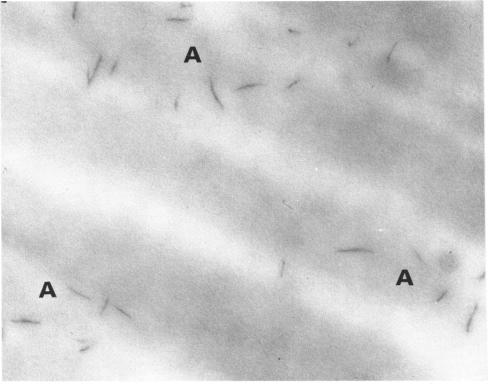
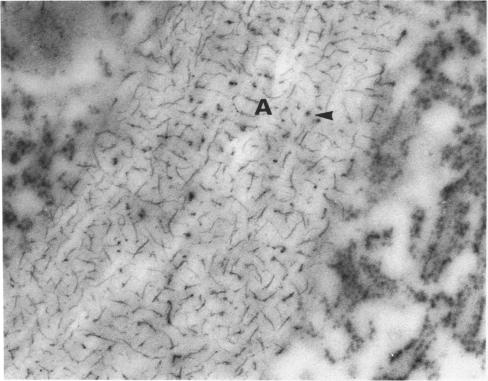
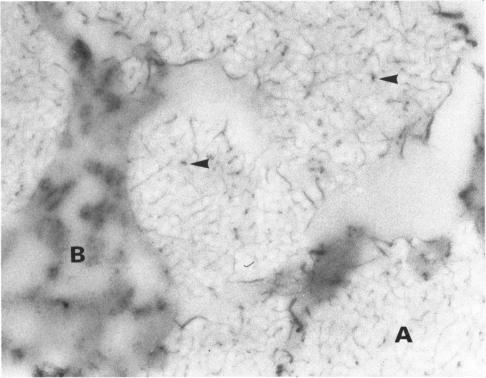
Proteoglycan in foetal- and adult-rat tail tendon and adult-rabbit achilles tendon was stained for electron microscopy with a cationic phthalocyanin-like dye, based on cinchomeronic acid, in a 'critical electrolyte concentration' method [Scott (1973) Biochem. Soc. Trans. 1, 787-806). Provided that the tissue was fixed with glutaraldehyde or formaldehyde, regular orthogonal perifibrillar arrays of filamentous material (proteoglycan) were observed, but no intra-fibrillar proteoglycan was seen. Specific proteoglycan-collagen interactions are inferred, and a model is proposed. Without fixation, the filamentous arrays disaggregated in the MgCl2 solutions (0.3 M) used during staining. End-to-end proteoglycan aggregation is implied. Tendon and cartilage are compared. Problems of electron-histochemical localization of extended space-filling polyanions by the use of cationic electron-dense precipitants are discussed, particularly polyanion-domain collapse, specificity of staining and fixation. A two-stage staining procedure that markedly enhances contrast is described, based on the multivalent nature of the dye, and the consequent anion-exchange properties of the dye-polyanion complex.
采用基于辛可宁酸的阳离子酞菁类染料,通过“临界电解质浓度”法,对胎鼠和成鼠尾腱以及成年兔跟腱中的蛋白聚糖进行电子显微镜染色[斯科特(1973年),《生物化学学会会报》1,787 - 806页]。只要组织用戊二醛或甲醛固定,就能观察到丝状物质(蛋白聚糖)规则的正交纤维周阵列,但未见到纤维内蛋白聚糖。由此推断出特定的蛋白聚糖 - 胶原蛋白相互作用,并提出了一个模型。未固定时,染色过程中使用的MgCl₂溶液(0.3M)会使丝状阵列解体。这意味着蛋白聚糖发生了端对端聚集。对腱和软骨进行了比较。讨论了使用阳离子电子致密沉淀剂对伸展性空间填充聚阴离子进行电子组织化学定位的问题,特别是聚阴离子结构域塌陷、染色特异性和固定问题。基于染料的多价性质以及由此产生的染料 - 聚阴离子复合物的阴离子交换特性,描述了一种能显著增强对比度的两步染色程序。