Tomoda A, Takizawa T, Tsuji A, Yoneyama Y
Biochem J. 1981 Jan 1;193(1):181-5. doi: 10.1042/bj1930181.
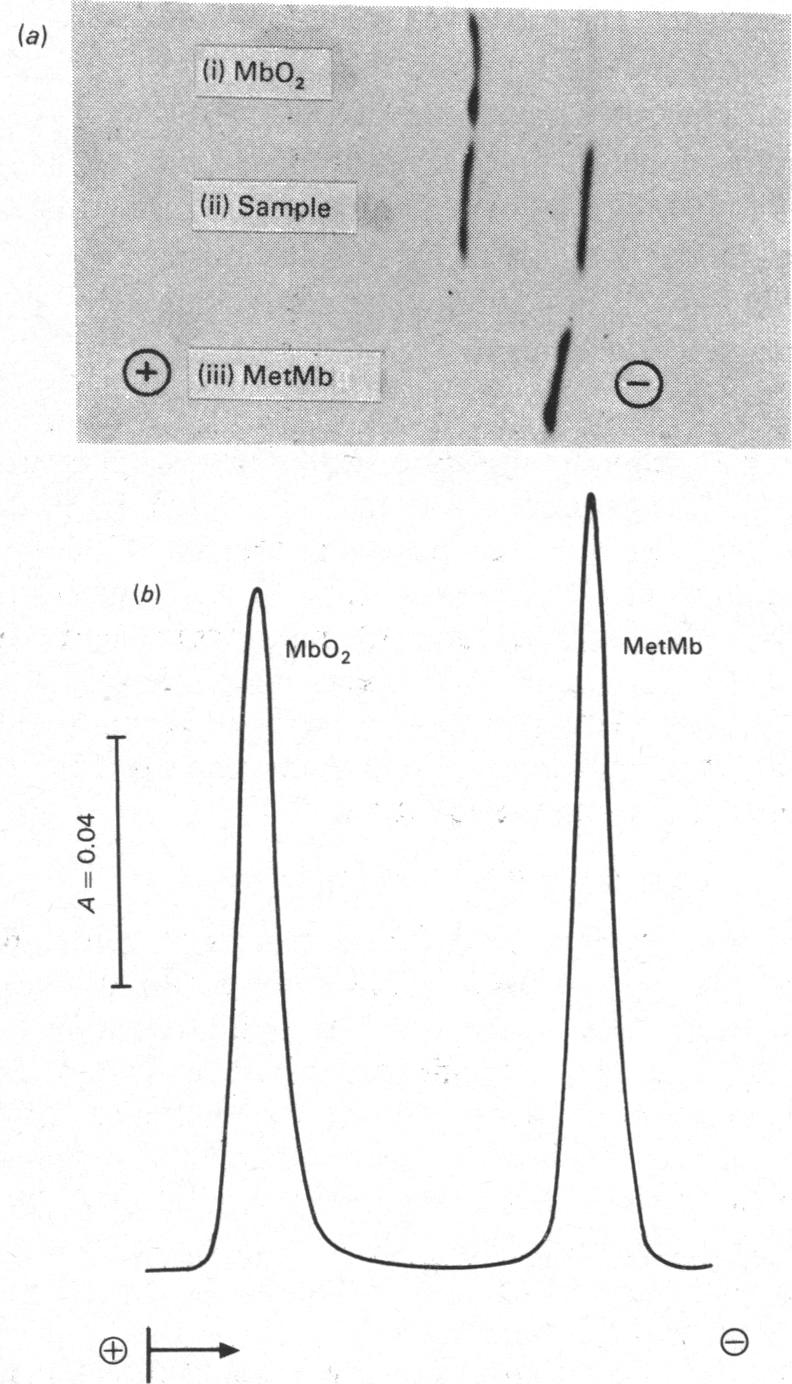
The autoxidation of horse myoglobin was studied in the presence or absence of catalase (EC 1.11.1.6) and/or superoxide dismutase (EC 1.15.1.1) at various pH values (6.6-7.8). Changes in the percentages of oxymyoglobin and metmyoglobin during the reaction were analysed by means of isoelectric focusing on Ampholine gel plates. Oxymyoglobin was decreased in a first-order manner, with an accompanying increase in metmyoglobin, under the various conditions studied. The observed reaction rate constants obtained under these conditions were pH-dependent; however, they were also greatly affected by the presence of the enzymes. The pH-dependence of the overall reaction was explained by the acid-base three-state model of myoglobin proposed by Shikama & Sugawara [(1978) Eur. J. Biochem. 91, 407-413]. The reaction process of myoglobin autoxidation was explained by the model suggested by Winterbourn, McGrath & Carrell [(1976) Biochem. J. 155, 493-502], indicating that superoxide anion and hydrogen peroxide are involved in the reaction mechanism.
在不同pH值(6.6 - 7.8)条件下,研究了在有或没有过氧化氢酶(EC 1.11.1.6)和/或超氧化物歧化酶(EC 1.15.1.1)存在时马肌红蛋白的自动氧化。通过在两性电解质凝胶板上进行等电聚焦分析反应过程中氧合肌红蛋白和高铁肌红蛋白百分比的变化。在所研究的各种条件下,氧合肌红蛋白以一级反应方式减少,同时高铁肌红蛋白增加。在这些条件下获得的观察反应速率常数与pH有关;然而,它们也受到酶的存在的极大影响。整体反应的pH依赖性由Shikama和Sugawara提出的肌红蛋白酸碱三态模型解释[(1978年)《欧洲生物化学杂志》91卷,407 - 413页]。肌红蛋白自动氧化的反应过程由Winterbourn、McGrath和Carrell提出的模型解释[(1976年)《生物化学杂志》155卷,493 - 502页],表明超氧阴离子和过氧化氢参与了反应机制。