Gibbons R J, Qureshi J V
Infect Immun. 1980 Sep;29(3):1082-91. doi: 10.1128/iai.29.3.1082-1091.1980.
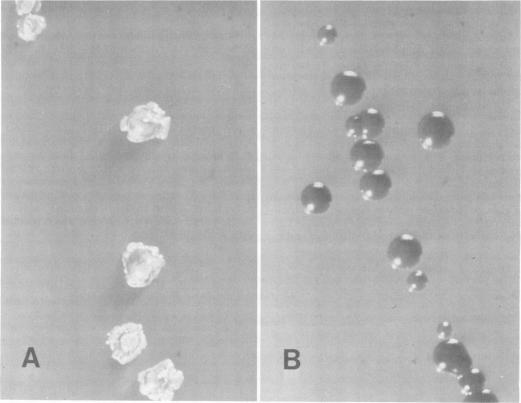
The purpose of this study was to determine if populations of Streptococcus mutans which were undergoing antigenic variation while colonizing gnotobiotic rats concomitantly became altered in physiological characteristics which affected their virulence. S. mutans strain JBP (serotype c), which was freshly isolated from a carious lesion in a 6-year old child, was used to inoculate gnotobiotic rats; uninfected animals served as controls. Substrains were isolated from animals 1, 2, 3, 4, and 12 weeks after infection; samples of pilocarpine-stimulated saliva were also obtained from representative animals for antibody analyses. Isolates derived from stock cultures of strain JBP proved to be homogeneous with respect to all of the physiological characteristics monitored. However, substrains isolated from the animals within 4 weeks after infection were altered with respect to their ability to agglutinate in the presence of sucrose, their ability to form adherent growth in sucrose broth, and the terminal pH attained in glucose broth. Some isolates obtained 12 weeks after infection no longer synthesized detectable levels of c antigen or intracellular glycogen, and they formed atypical smooth colonies on mitis salivarius agar. With an enzyme-linked immunosorbent assay, low levels of immunoglobulin A (IgA) antibodies reactive with whole JBP cells were detected in saliva samples of uninfected control animals at each sampling period; these evidently were induced to antigens contained in the diet of the animals. Significantly higher levels of IgA antibodies were present in saliva samples from animals infected with strain JBP for 3 weeks or longer. Thus, the emergence of antigenic and physiological variants of S. mutans in the animals was paralleled by increased levels of salivary IgA antibodies. The reactivity of salivary IgG with JBP cells was low, and it fluctuated in both groups of animals. No antibodies of the IgM class were detected. When tested in gnotobiotic rats, several variants, including strains which no longer formed typical rough colonies or adherent growth in sucrose broth, proved much less virulent than parental strain JBP in inducing carious lesions. Prior oral immunization, which resulted in higher levels of salivary and serum IgA antibodies reactive with strain JBP, was found to accelerate the emergence of smooth-colony variants in the animals; it was also associated with decreased streptococcal population levels on the teeth and in feces of the rats. It is suggested that part of the mechanism by which artificial immunization leads to a reduction in dental caries development in experimental animals is due to the earlier selection of less virulent streptococcal populations.
本研究的目的是确定在定殖于悉生大鼠的过程中经历抗原变异的变形链球菌群体,其生理特性是否会发生改变,从而影响其毒力。从一名6岁儿童的龋损中新鲜分离出的变形链球菌菌株JBP(血清型c)用于接种悉生大鼠;未感染的动物作为对照。在感染后1、2、3、4和12周从动物体内分离出亚菌株;还从代表性动物中获取毛果芸香碱刺激的唾液样本进行抗体分析。源自菌株JBP原种培养物的分离株在所有监测的生理特性方面均表现出一致性。然而,在感染后4周内从动物体内分离出的亚菌株,在蔗糖存在下的凝集能力、在蔗糖肉汤中形成附着生长的能力以及在葡萄糖肉汤中达到的终末pH值方面发生了改变。在感染12周后获得的一些分离株不再合成可检测水平的c抗原或细胞内糖原,并且它们在涎链球菌琼脂上形成非典型的光滑菌落。通过酶联免疫吸附测定法,在每个采样期未感染对照动物的唾液样本中检测到低水平的与整个JBP细胞反应的免疫球蛋白A(IgA)抗体;这些抗体显然是由动物饮食中所含的抗原诱导产生的。在感染菌株JBP 3周或更长时间的动物的唾液样本中,IgA抗体水平显著更高。因此,动物体内变形链球菌抗原和生理变异株的出现与唾液IgA抗体水平的升高是平行的。唾液IgG与JBP细胞的反应性较低,并且在两组动物中都有波动。未检测到IgM类抗体。在悉生大鼠中进行测试时,几种变异株,包括不再在蔗糖肉汤中形成典型粗糙菌落或附着生长的菌株,在诱导龋损方面的毒力比亲本菌株JBP低得多。先前的口服免疫导致与菌株JBP反应的唾液和血清IgA抗体水平升高,发现这会加速动物体内光滑菌落变异株的出现;这也与大鼠牙齿和粪便中链球菌群体水平的降低有关。有人提出,人工免疫导致实验动物龋齿发展减少的部分机制是由于更早地选择了毒力较低的链球菌群体。