Orlow S J, Hearing V J, Sakai C, Urabe K, Zhou B K, Silvers W K, Mintz B
Ronald O. Perelman Department of Dermatology, New York University School of Medicine, New York 10016, USA.
Proc Natl Acad Sci U S A. 1995 Oct 24;92(22):10152-6. doi: 10.1073/pnas.92.22.10152.
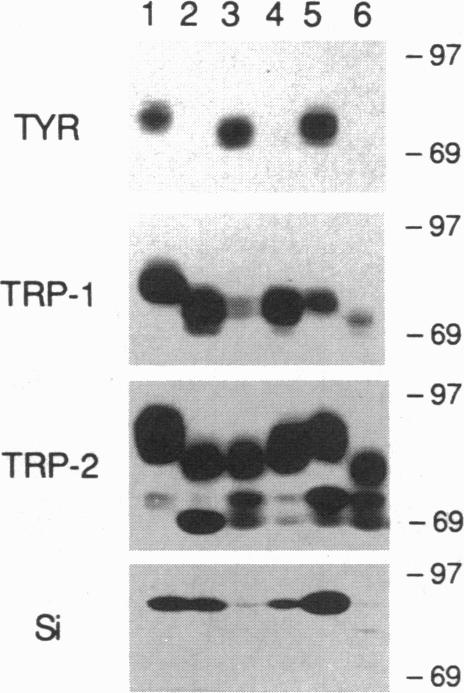
Cutaneous melanomas of Tyr-SV40E transgenic mice (mice whose transgene consists of the tyrosinase promoter fused to the coding regions of simian virus 40 early genes) strikingly resemble human melanomas in their development and progression. Unlike human melanomas, the mouse tumors all arise in genetically identical individuals, thereby better enabling expression of specific genes to be characterized in relation to advancing malignancy. The products of pigment genes are of particular interest because peptides derived from these proteins have been reported to function as autoantigens with immunotherapeutic potential in some melanoma patients. However, the diminished pigmentation characteristic of many advanced melanomas raises the possibility that some of the relevant products may no longer be expressed in the most malignant cells. We have therefore investigated the contributions of several pigment genes in melanotic vs. relatively amelanotic components of primary and metastatic mouse melanomas. The analyses reveal marked differences within and among tumors in levels of mRNAs and proteins encoded by the wild-type alleles at the albino, brown, slaty, and silver loci. Tyrosinase (the protein encoded by the albino locus) was most often either absent or undetectable as melanization declined. The protein encoded by the slaty locus (tyrosinase-related protein 2) was the only one of those tested that was clearly present in all the tumor samples. These results suggest that sole reliance on targeting tyrosinase-based antigens might selectively favor survival of more malignant cells, whereas targeting the ensemble of the antigens tested might contribute toward a more inclusive and effective antimelanoma strategy.
酪氨酸 - SV40E转基因小鼠(其转基因由与猿猴病毒40早期基因编码区融合的酪氨酸酶启动子组成)的皮肤黑色素瘤在其发生和发展过程中与人类黑色素瘤极为相似。与人类黑色素瘤不同的是,小鼠肿瘤均发生在基因相同的个体中,从而更有助于在恶性进展过程中对特定基因的表达进行表征。色素基因的产物特别令人感兴趣,因为据报道,源自这些蛋白质的肽在一些黑色素瘤患者中可作为具有免疫治疗潜力的自身抗原发挥作用。然而,许多晚期黑色素瘤色素沉着减少的特征增加了一种可能性,即一些相关产物可能在最恶性的细胞中不再表达。因此,我们研究了几种色素基因在原发性和转移性小鼠黑色素瘤的黑色素成分与相对无黑色素成分中的作用。分析揭示了在白化病、棕色、石板色和银色位点上,野生型等位基因编码的mRNA和蛋白质水平在肿瘤内部和肿瘤之间存在显著差异。酪氨酸酶(由白化病位点编码的蛋白质)随着黑色素沉着的减少最常缺失或无法检测到。石板色位点编码的蛋白质(酪氨酸酶相关蛋白2)是所有测试样本中唯一在所有肿瘤样本中均明显存在的蛋白质。这些结果表明,单纯依赖靶向基于酪氨酸酶的抗原可能会选择性地促进更恶性细胞的存活,而靶向所测试的抗原组合可能有助于制定更全面、有效的抗黑色素瘤策略。