Modderman P W, von dem Borne A E, Sonnenberg A
Department of Immunohaematology, The Netherlands Red Cross Blood Transfusion Service, Amsterdam.
Biochem J. 1994 May 1;299 ( Pt 3)(Pt 3):613-21. doi: 10.1042/bj2990613.
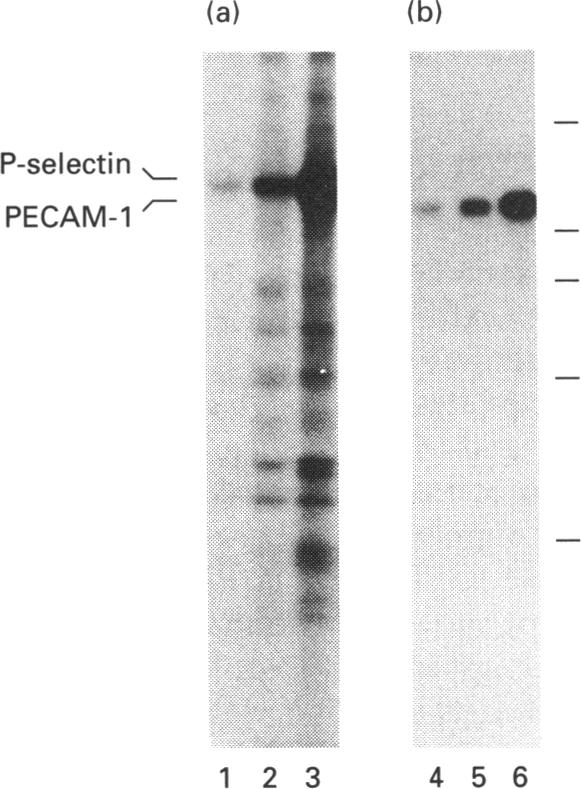
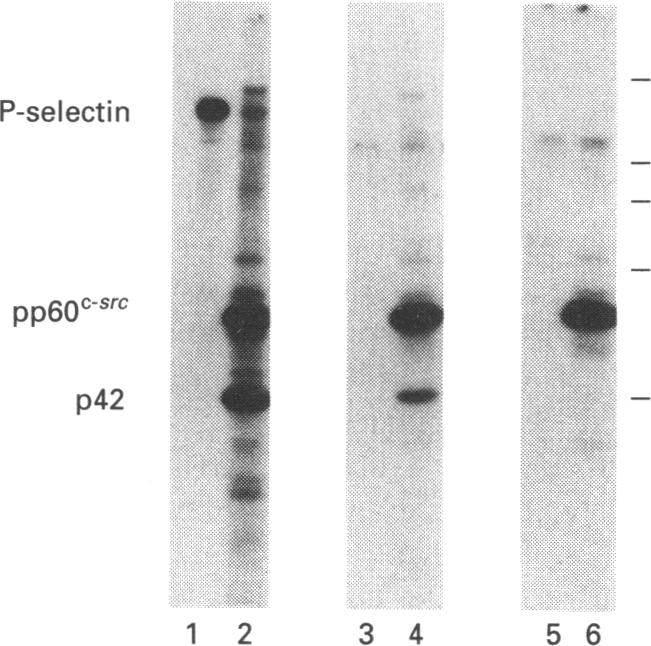
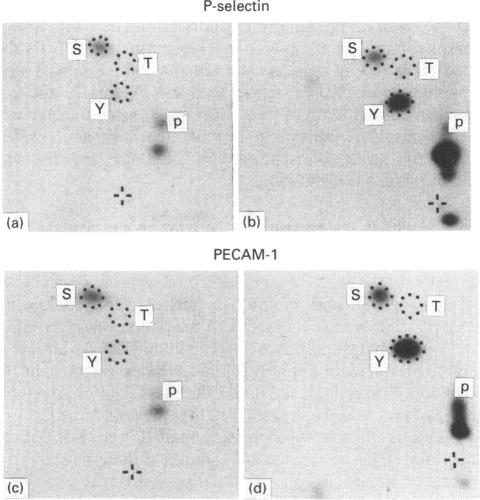
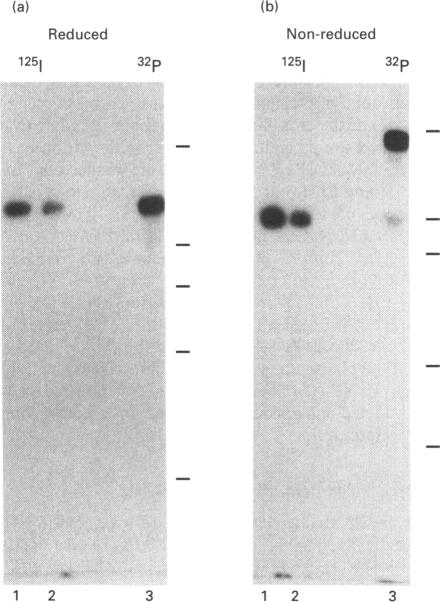
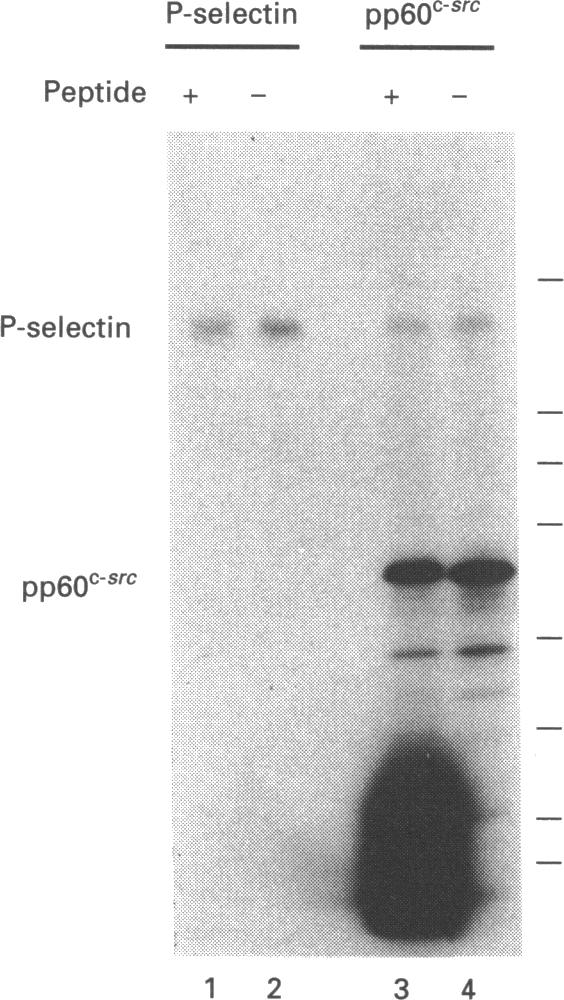
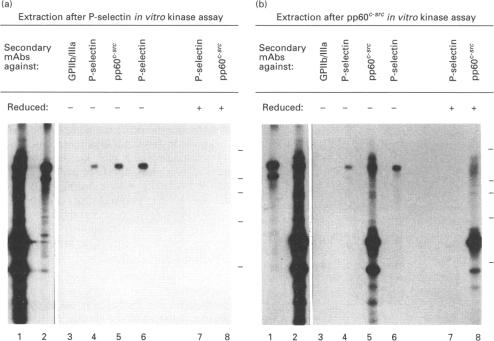
P-selectin is a 140 kDa membrane glycoprotein found in secretory granules of platelets and endothelial cells where it is rapidly translocated to the plasma membrane upon cell activation. It then functions as a receptor for various types of leucocytes. Metabolic labelling of resting platelets with 32Pi showed that P-selectin is primarily phosphorylated on serine residues, although some tyrosine phosphorylation was observed as well. However, tyrosine phosphorylation of P-selectin was greatly stimulated by treatment with the permeating phosphatase inhibitor, pervanadate. When P-selectin immunoprecipitates were incubated with [gamma-32P]ATP (in vitro kinase assay), a fraction of P-selectin was phosphorylated on its tyrosine residues by a co-precipitated kinase. P-selectin phosphorylated in vitro co-migrated with 140 kDa surface-labelled 125I-P-selectin during SDS/PAGE under reducing conditions. Under non-reducing conditions, however, phosphorylated P-selectin was disulphide-linked to unknown protein(s) in a 205 kDa complex. In vitro kinase assays of the most abundant platelet tyrosine kinase, pp60c-src, demonstrated the presence of similar 140 and 205 kDa phosphorylated proteins in SDS/PAGE under reducing and non-reducing conditions respectively. Extraction and reprecipitation studies with proteins phosphorylated in vitro indicated that P-selectin and pp60c-src form a 205 kDa 1:1 disulphide-linked complex. In the complex, pp60c-src autophosphorylation is inhibited and P-selectin is phosphorylated on tyrosine residues. As protein disulphides in the cytoplasm of intact cells are extremely rare, our results suggest that P-selectin and pp60c-src, which co-localize in platelet dense granules, may be non-covalently associated and spontaneously form disulphide bridges during lysis. In addition, the observed tyrosine phosphorylation of P-selectin in intact platelets suggests that its function might be regulated by phosphorylation by pp60c-src.
P-选择素是一种140 kDa的膜糖蛋白,存在于血小板和内皮细胞的分泌颗粒中,细胞激活后它会迅速转移到质膜上。然后它作为各种类型白细胞的受体发挥作用。用32Pi对静息血小板进行代谢标记显示,P-选择素主要在丝氨酸残基上磷酸化,不过也观察到了一些酪氨酸磷酸化。然而,用渗透性磷酸酶抑制剂过钒酸盐处理可极大地刺激P-选择素的酪氨酸磷酸化。当P-选择素免疫沉淀物与[γ-32P]ATP一起温育(体外激酶测定)时,一部分P-选择素通过共沉淀激酶在其酪氨酸残基上被磷酸化。在还原条件下进行SDS/PAGE时,体外磷酸化的P-选择素与140 kDa表面标记的125I-P-选择素共迁移。然而,在非还原条件下,磷酸化的P-选择素通过二硫键与205 kDa复合物中的未知蛋白质相连。对最丰富的血小板酪氨酸激酶pp60c-src进行的体外激酶测定表明,在还原和非还原条件下,SDS/PAGE中分别存在类似的140和205 kDa磷酸化蛋白质。对体外磷酸化的蛋白质进行提取和再沉淀研究表明,P-选择素和pp60c-src形成了一个205 kDa的1:1二硫键连接复合物。在该复合物中,pp60c-src的自身磷酸化受到抑制,P-选择素在酪氨酸残基上被磷酸化。由于完整细胞细胞质中的蛋白质二硫键极其罕见,我们的结果表明,共定位于血小板致密颗粒中的P-选择素和pp60c-src可能是非共价结合的,并在裂解过程中自发形成二硫键。此外,在完整血小板中观察到的P-选择素酪氨酸磷酸化表明,其功能可能受pp60c-src磷酸化的调节。