Bois-Joyeux B, Danan J L
Centre de Recherche sur l'Endocrinologie Moléculaire et le Développement, CNRS UPR 1511, Meudon, France.
Biochem J. 1994 Jul 1;301 ( Pt 1)(Pt 1):49-55. doi: 10.1042/bj3010049.
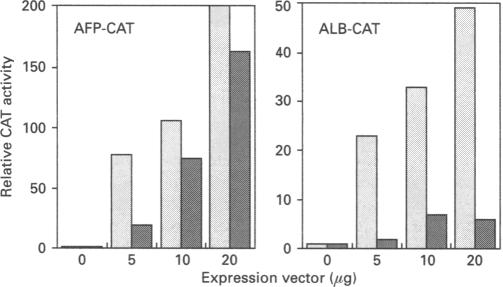
The promoter of the rat alpha-fetoprotein (AFP) gene, which makes the expression of the developmentally regulated AFP gene specific to the liver, is a putative target for transcription factors of the CAAT/enhancer-binding protein (C/EBP), hepatocyte nuclear factor-1 (HNF-1) and nuclear factor-1 (NF-1) families. We have evaluated the influence of these factors on the activity of the AFP promoter by transfection of HepG2 hepatoma cells with the appropriate expression vector plus a CAT plasmid under the control of the AFP promoter. A similar plasmid bearing the rat albumin promoter was used as a control. C/EBP alpha, C/EBP beta and D-binding protein (DBP) acted as trans-activators on the AFP promoter, whereas liver inhibitory protein (LIP), a truncated form of C/EBP beta, was a potent negative regulator of the promoter. C/EBP alpha also bound to and stimulated the activity of the AFP enhancer at -2.5 kb. Interestingly, HNF-1 beta was found to be more potent than HNF-1 alpha in activating the AFP promoter. This effect was specific, as it did not occur with the rat albumin promoter. HNF-1 beta, which is produced earlier than HNF-1 alpha during liver development, would thus have the greater influence on the AFP promoter in early development. Both HNF-1s allowed expression of the AFP promoter in cells of nonhepatic origin. Overexpression of NF-1 induced a specific decrease in the activity of the AFP promoter. This strongly suggests that competition between NF-1 and HNF-1 for binding to their overlapping binding sites on the AFP promoter is critical for modulating its activity. Thus changing combinations of these trans-acting factors may tightly modulate the AFP promoter activity in the course of liver development and carcinogenesis.
大鼠甲胎蛋白(AFP)基因的启动子可使发育调控的AFP基因在肝脏中特异性表达,它是CCAAT/增强子结合蛋白(C/EBP)、肝细胞核因子-1(HNF-1)和核因子-1(NF-1)家族转录因子的假定作用靶点。我们通过用合适的表达载体转染HepG2肝癌细胞,并在AFP启动子控制下加入一个CAT质粒,评估了这些因子对AFP启动子活性的影响。一个带有大鼠白蛋白启动子的类似质粒用作对照。C/EBPα、C/EBPβ和D结合蛋白(DBP)对AFP启动子起反式激活作用,而C/EBPβ的截短形式肝抑制蛋白(LIP)是该启动子的有效负调控因子。C/EBPα也结合并刺激了-2.5 kb处AFP增强子的活性。有趣的是,发现HNF-1β在激活AFP启动子方面比HNF-1α更有效。这种作用是特异性的,因为大鼠白蛋白启动子未出现这种情况。在肝脏发育过程中产生时间早于HNF-1α的HNF-1β,因此在早期发育中对AFP启动子的影响更大。两种HNF-1均使非肝源性细胞中AFP启动子得以表达。NF-1的过表达导致AFP启动子活性特异性降低。这强烈表明,NF-1和HNF-1在AFP启动子上与其重叠结合位点的结合竞争对于调节其活性至关重要。因此,这些反式作用因子组合的变化可能在肝脏发育和癌变过程中紧密调节AFP启动子的活性。