Senger D R, Perruzzi C A, Papadopoulos-Sergiou A, Van de Water L
Department of Pathology, Beth Israel Hospital, Boston, Massachusetts.
Mol Biol Cell. 1994 May;5(5):565-74. doi: 10.1091/mbc.5.5.565.
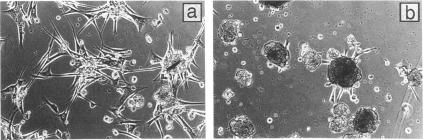
Osteopontin (OPN) is a secreted adhesive glycoprotein with a functional glycine-arginine-glycine-aspartate-serine (GRGDS) cell-binding domain. An interesting feature of OPN structure is the presence of a thrombin-cleavage site in close proximity to the GRGDS region. Cleavage of OPN by thrombin is likely to be of physiological importance, because cleavage of blood plasma OPN occurs naturally after activation of the blood coagulation pathway. To investigate functional consequences of OPN cleavage by thrombin, cell attachment and spreading assays were performed with uncleaved and cleaved forms of OPN. For all cell lines examined, thrombin-cleaved OPN promoted markedly greater cell attachment and spreading than uncleaved OPN. Cell attachment and spreading on thrombin-cleaved OPN was inhibited both by the soluble GRGDS peptides and an OPN-specific antibody raised to the GRGDS domain of OPN, thus implicating the GRGDS region in mediating the increased cell attachment and spreading observed on thrombin-cleaved OPN. Because the GRGDS sequence in OPN is only six residues from the thrombin-cleavage site, the data suggest that possibility that thrombin cleavage allows greater accessibility of the GRGDS domain to cell surface receptors. To investigate receptors that recognize uncleaved and thrombin-cleaved OPN, affinity chromatography was performed on placental extracts; the cell surface integrin alpha v beta 3 bound to columns constructed either with native or thrombin-cleaved OPN and was selectively eluted from each with soluble GRGDS peptide and EDTA. Moreover, adhesion assays performed in the presence of alpha v beta 3 blocking monoclonal antibody LM609 identified alpha v beta 3 as a major functional receptor for thrombin-cleaved OPN. Several lines of evidence suggest that cleavage of OPN by thrombin occurs in vivo, such as in tumors and at sites of tissue injury, and adhesion assay data presented here indicate that such cleavage is important in the regulation of OPN function.
骨桥蛋白(OPN)是一种分泌型黏附糖蛋白,具有功能性甘氨酸 - 精氨酸 - 甘氨酸 - 天冬氨酸 - 丝氨酸(GRGDS)细胞结合结构域。OPN结构的一个有趣特征是在靠近GRGDS区域存在一个凝血酶切割位点。凝血酶对OPN的切割可能具有生理重要性,因为血浆OPN的切割在凝血途径激活后自然发生。为了研究凝血酶切割OPN的功能后果,用未切割和切割形式的OPN进行了细胞黏附和铺展试验。对于所有检测的细胞系,凝血酶切割的OPN比未切割的OPN显著促进更大程度的细胞黏附和铺展。可溶性GRGDS肽和针对OPN的GRGDS结构域产生的OPN特异性抗体均抑制细胞在凝血酶切割的OPN上的黏附和铺展,因此表明GRGDS区域介导了在凝血酶切割的OPN上观察到的细胞黏附和铺展增加。由于OPN中的GRGDS序列距离凝血酶切割位点仅六个残基,数据表明凝血酶切割使GRGDS结构域更易接近细胞表面受体。为了研究识别未切割和凝血酶切割的OPN的受体,对胎盘提取物进行了亲和层析;细胞表面整合素αvβ3与用天然或凝血酶切割的OPN构建的柱结合,并用可溶性GRGDS肽和EDTA从每个柱中选择性洗脱。此外,在αvβ3阻断单克隆抗体LM609存在下进行的黏附试验确定αvβ3是凝血酶切割的OPN的主要功能受体。几条证据表明凝血酶对OPN的切割在体内发生,如在肿瘤和组织损伤部位,此处呈现的黏附试验数据表明这种切割在OPN功能调节中很重要。