Mosner J, Mummenbrauer T, Bauer C, Sczakiel G, Grosse F, Deppert W
Heinrich-Pette-Institut für Experimentelle Virologie und Immunologie, Universität Hamburg, Germany.
EMBO J. 1995 Sep 15;14(18):4442-9. doi: 10.1002/j.1460-2075.1995.tb00123.x.
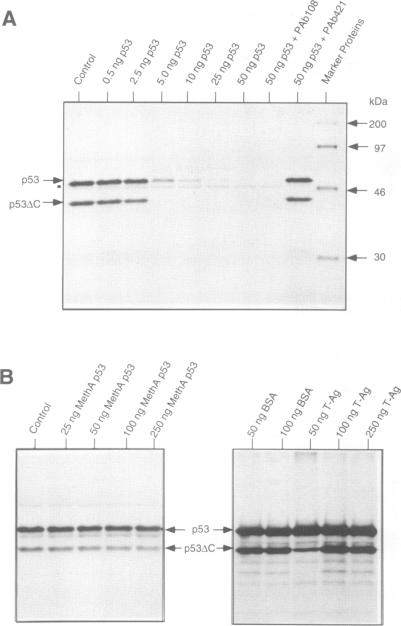
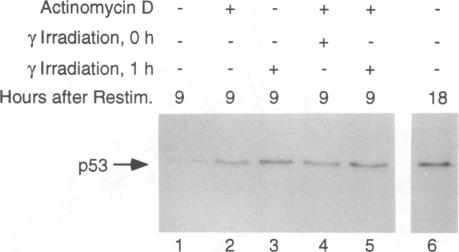
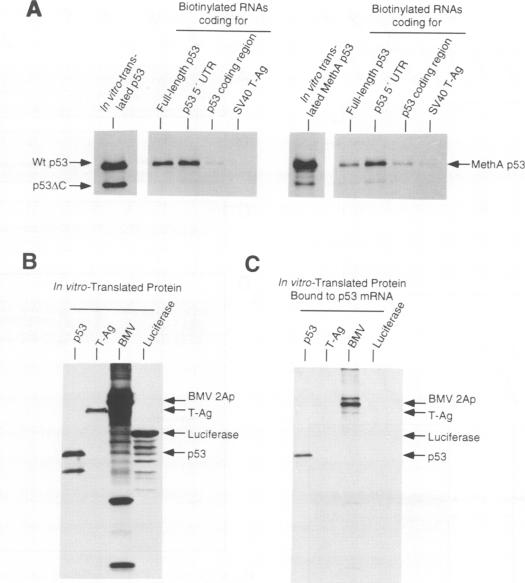
When growth-arrested mouse fibroblasts re-entered the cell-cycle, the rise in tumour suppressor p53 mRNA level markedly preceded the rise in expression of the p53 protein. Furthermore, gamma-irradiation of such cells led to a rapid increase in p53 protein biosynthesis even in the presence of the transcription inhibitor actinomycin D. Both findings strongly suggest that p53 biosynthesis in these cells is regulated at the translational level. We present evidence for an autoregulatory control of p53 expression by a negative feed-back loop: p53 mRNA has a predicted tendency to form a stable stem-loop structure that involves the 5'-untranslated region (5'-UTR) plus some 280 nucleotides of the coding sequence. p53 binds tightly to the 5'-UTR region and inhibits the translation of its own mRNA, most likely mediated by the p53-intrinsic RNA re-annealing activity. The inhibition of p53 biosynthesis requires wild-type p53, as it is not observed with MethA mutant p53, p53-catalysed translational inhibition is selective; it might be restricted to p53 mRNA and a few other mRNAs that are able to form extensive stem-loop structures. Release from negative feed-back regulation of p53 biosynthesis, e.g. after damage-induced nuclear transport of p53, might provide a means for rapidly increasing p53 protein levels when p53 is required to act as a cell-cycle checkpoint determinant after DNA damage.
当生长停滞的小鼠成纤维细胞重新进入细胞周期时,肿瘤抑制因子p53 mRNA水平的升高明显先于p53蛋白表达的升高。此外,对这类细胞进行γ射线照射,即使在存在转录抑制剂放线菌素D的情况下,也会导致p53蛋白生物合成迅速增加。这两个发现都强烈表明,这些细胞中p53的生物合成在翻译水平受到调控。我们提供了一个通过负反馈环对p53表达进行自动调节控制的证据:p53 mRNA有一种预测的倾向,即形成一个稳定的茎环结构,该结构涉及5'-非翻译区(5'-UTR)加上编码序列的约280个核苷酸。p53与5'-UTR区域紧密结合,并抑制其自身mRNA的翻译,最有可能是由p53内在的RNA重新退火活性介导的。对p53生物合成的抑制需要野生型p53,因为在MethA突变型p53中未观察到这种抑制,p53催化的翻译抑制具有选择性;它可能仅限于p53 mRNA和其他一些能够形成广泛茎环结构的mRNA。例如,在损伤诱导p53核转运后,从p53生物合成的负反馈调节中释放出来,可能为在DNA损伤后p53需要作为细胞周期检查点决定因素时快速增加p53蛋白水平提供一种手段。