Dou Q P, An B, Will P L
Department of Pharmacology, University of Pittsburgh School of Medicine, PA, USA.
Proc Natl Acad Sci U S A. 1995 Sep 26;92(20):9019-23. doi: 10.1073/pnas.92.20.9019.
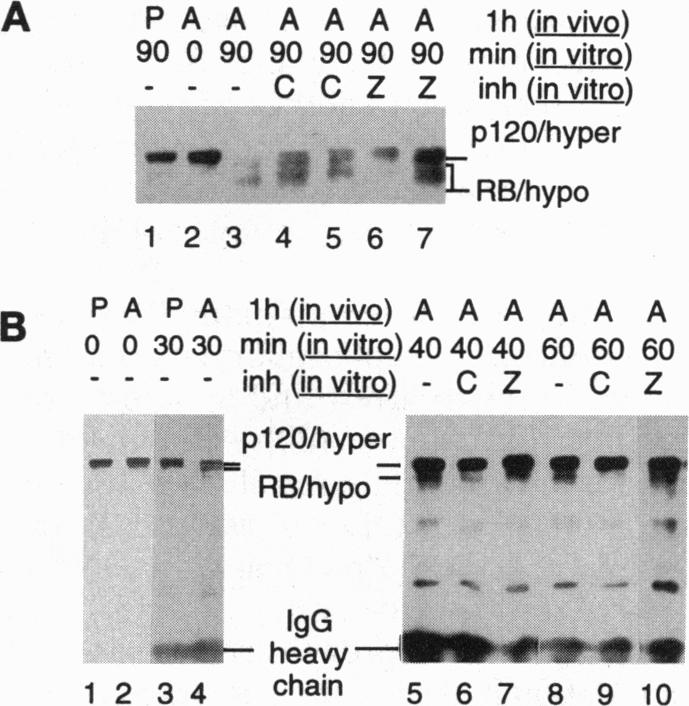
DNA-damaging agents induce accumulation of the tumor suppressor and G1 checkpoint protein p53, leading cells to either growth arrest in G1 or apoptosis (programmed cell death). The p53-dependent G1 arrest involves induction of p21 (also called WAF1/CIP1/SDI1), which prevents cyclin kinase-mediated phosphorylation of retinoblastoma protein (RB). Recent studies suggest a p53-independent G1 checkpoint as well; however, little is known about its molecular mechanisms. We report that induction of a protein-serine/threonine phosphatase activity by DNA damage signals is at least one of the mechanisms responsible for p53-independent, RB-mediated G1 arrest and consequent apoptosis. When two p53-null human leukemic cell lines (HL-60 and U-937) were treated with a variety of anticancer agents, RB became hypophosphorylated, accompanied with G1 arrest. This was followed immediately (in less than 30 min) by apoptosis, as determined by the accumulation of pre-G1 apoptotic cells and the internucleosomal fragmentation of DNA. Addition of calyculin A or okadaic acid (specific serine/threonine phosphatase inhibitors) or zinc chloride (apoptosis inhibitor) prevented the G1 arrest- and apoptosis-specific RB dephosphorylation. The levels of cyclin E- and cyclin A-associated kinase activities remained high during RB dephosphorylation, supporting the involvement of a chemotherapy-induced serine/threonine phosphatase(s) rather than p21. Furthermore, the induced phosphatase activity coimmunoprecipitated with the hyperphosphorylated RB and was active in a cell-free system that reproduced the growth arrest- and apoptosis-specific RB dephosphorylation, which was inhibitable by calyculin A but not zinc. We propose that the RB phosphatase(s) might be one of the p53-independent G1 checkpoint regulators.
DNA损伤剂可诱导肿瘤抑制因子及G1期检查点蛋白p53的积累,使细胞在G1期生长停滞或发生凋亡(程序性细胞死亡)。p53依赖的G1期停滞涉及p21(也称为WAF1/CIP1/SDI1)的诱导,p21可阻止细胞周期蛋白激酶介导的视网膜母细胞瘤蛋白(RB)磷酸化。最近的研究也提示存在不依赖p53的G1期检查点;然而,其分子机制却知之甚少。我们报告,DNA损伤信号诱导的一种蛋白丝氨酸/苏氨酸磷酸酶活性至少是不依赖p53、由RB介导的G1期停滞及随后凋亡的机制之一。当用多种抗癌药物处理两种p53缺失的人白血病细胞系(HL-60和U-937)时,RB发生低磷酸化,并伴随G1期停滞。随后立即(不到30分钟)发生凋亡,这可通过G1期前凋亡细胞的积累和DNA的核小体间断裂来确定。加入花萼海绵诱癌素A或冈田酸(特异性丝氨酸/苏氨酸磷酸酶抑制剂)或氯化锌(凋亡抑制剂)可阻止G1期停滞及凋亡特异性的RB去磷酸化。在RB去磷酸化过程中,细胞周期蛋白E和细胞周期蛋白A相关激酶活性水平保持较高,这支持了化疗诱导的丝氨酸/苏氨酸磷酸酶而非p21的参与。此外,诱导的磷酸酶活性与高磷酸化的RB共免疫沉淀,并且在一个无细胞系统中具有活性,该系统重现了生长停滞及凋亡特异性的RB去磷酸化,这种去磷酸化可被花萼海绵诱癌素A抑制,但不能被氯化锌抑制。我们提出,RB磷酸酶可能是不依赖p53的G1期检查点调节因子之一。