Jordan N J, Watson M L, Westwick J
Department of Pharmacology, University of Bath, Claverton Down, U.K.
Biochem J. 1995 Oct 1;311 ( Pt 1)(Pt 1):89-95. doi: 10.1042/bj3110089.
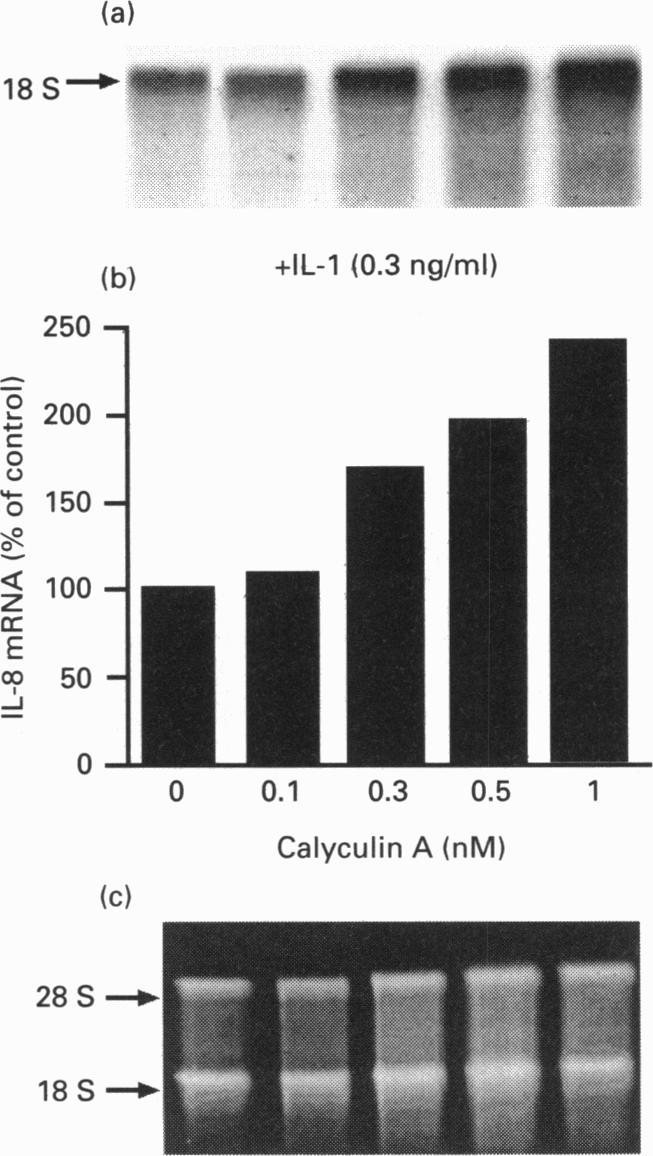
Cultured human synovial fibroblasts express mRNA for the chemotactic cytokines (chemokines) interleukin-8 (IL-8), monocyte chemotactic protein 1 (MCP-1) and regulated upon activation normal T-cell expressed and presumably secreted (RANTES), when stimulated with IL-1 or tumour necrosis factor alpha (TNF alpha). Calyculin A, a potent type 1/2A protein serine/threonine phosphatase inhibitor, was used to examine the role of protein phosphatases in the regulation of chemokine gene expression. Calyculin A (1 nM) mimicked IL-1 by inducing IL-8 and MCP-1 mRNA expression in synovial cells. IL-8 mRNA was induced over a similar time period (1-6 h) in response to IL-1 or calyculin A, whereas MCP-1 mRNA was induced more rapidly (1-2 h) by calyculin A than by IL-1 (4-6 h). Expression of RANTES mRNA occurred in response to TNF alpha, but could not be induced by stimulation with calyculin A alone. These results suggest that inhibition of protein phosphatase type 1/2A may have a differential role in the regulation of the expression of each of the chemokine genes. Synovial fibroblasts also secreted IL-8 and IL-6 peptide when stimulated with either IL-1/TNF alpha or calyculin A. The amount of IL-8 and IL-6 peptide produced in response to calyculin A was significantly increased above that produced by untreated synovial cells, though it was much less than the amount induced by IL-1 or TNF alpha. Calyculin A also acted synergistically with IL-1 or TNF alpha to cause a 2-fold potentiation of IL-1- or TNF alpha-induced IL-8 mRNA and peptide and RANTES mRNA expression. These results suggest that although inhibition of a protein phosphatase may be able to regulate the magnitude of IL-1-induced chemokine gene expression, the IL-1 signal transduction pathway involves components in addition to phosphatase inhibition, possibly including the activation of a protein kinase, the action of which may be opposed by a protein phosphatase inhibited by calyculin A.
当受到白细胞介素 -1(IL -1)或肿瘤坏死因子α(TNFα)刺激时,培养的人滑膜成纤维细胞会表达趋化细胞因子(趋化因子)白细胞介素 -8(IL -8)、单核细胞趋化蛋白1(MCP -1)以及活化后正常T细胞表达并可能分泌的因子(RANTES)的信使核糖核酸(mRNA)。花萼海绵诱癌素A是一种有效的1/2A 型蛋白丝氨酸/苏氨酸磷酸酶抑制剂,被用于研究蛋白磷酸酶在趋化因子基因表达调控中的作用。花萼海绵诱癌素A(1纳摩尔)通过诱导滑膜细胞中IL -8和MCP -1的mRNA表达来模拟IL -1的作用。在对IL -1或花萼海绵诱癌素A的反应中,IL -8的mRNA在相似的时间段(1 - 6小时)内被诱导产生,而花萼海绵诱癌素A诱导MCP -1的mRNA产生的速度比IL -1(4 - 6小时)更快(1 - 2小时)。RANTES的mRNA表达是对TNFα的反应,但单独用花萼海绵诱癌素A刺激并不能诱导其产生。这些结果表明,抑制1/2A 型蛋白磷酸酶在调控每种趋化因子基因的表达中可能具有不同的作用。当用IL -1/TNFα或花萼海绵诱癌素A刺激时,滑膜成纤维细胞也会分泌IL -8和IL -6肽。与未处理的滑膜细胞相比,花萼海绵诱癌素A刺激产生的IL -8和IL -6肽的量显著增加,尽管比IL -1或TNFα诱导产生的量要少得多。花萼海绵诱癌素A还与IL -1或TNFα协同作用,使IL -1或TNFα诱导的IL -8 mRNA和肽以及RANTES mRNA表达增强两倍。这些结果表明,虽然抑制一种蛋白磷酸酶可能能够调节IL -1诱导的趋化因子基因表达的程度,但IL -1信号转导途径除了磷酸酶抑制外还涉及其他成分,可能包括蛋白激酶的激活,而蛋白激酶的作用可能被花萼海绵诱癌素A抑制的蛋白磷酸酶所拮抗。