Beg A A, Finco T S, Nantermet P V, Baldwin A S
Lineberger Comprehensive Cancer Center, University of North Carolina, Chapel Hill 27599.
Mol Cell Biol. 1993 Jun;13(6):3301-10. doi: 10.1128/mcb.13.6.3301-3310.1993.
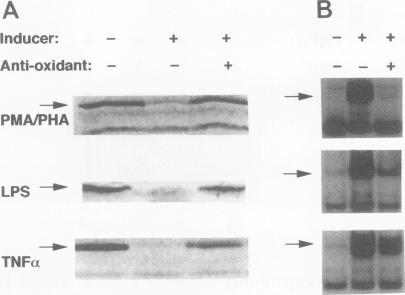
Nuclear factor kappa B (NF-kappa B) is a critical regulator of several genes which are involved in immune and inflammation responses. NF-kappa B, consisting of a 50-kDa protein (p50) and a 65-kDa protein (p65), is bound to a cytoplasmic retention protein called I kappa B. Stimulation of cells with a variety of inducers, including cytokines such as tumor necrosis factor and interleukin-1, leads to the activation and the translocation of p50/65 NF-kappa B into the nucleus. However, the in vivo mechanism of the activation process remains unknown. Here, we provide the first evidence that the in vivo mechanism of NF-kappa B activation is through the phosphorylation and subsequent loss of its inhibitor, I kappa B alpha. We also show that both I kappa B alpha loss and NF-kappa B activation are inhibited in the presence of antioxidants, demonstrating that the loss of I kappa B alpha is a prerequisite for NF-kappa B activation. Finally, we demonstrate that I kappa B alpha is rapidly resynthesized after loss, indicating that an autoregulatory mechanism is involved in the regulation of NF-kappa B function. We propose a mechanism for the activation of NF-kappa B through the modification and loss of I kappa B alpha, thereby establishing its role as a mediator of NF-kappa B activation.
核因子κB(NF-κB)是多种参与免疫和炎症反应的基因的关键调节因子。NF-κB由一个50千道尔顿的蛋白质(p50)和一个65千道尔顿的蛋白质(p65)组成,与一种名为IκB的细胞质滞留蛋白结合。用多种诱导剂刺激细胞,包括肿瘤坏死因子和白细胞介素-1等细胞因子,会导致p50/65 NF-κB激活并转移到细胞核中。然而,激活过程的体内机制仍然未知。在这里,我们提供了首个证据,即NF-κB激活的体内机制是通过其抑制剂IκBα的磷酸化及随后的缺失。我们还表明,在抗氧化剂存在的情况下,IκBα的缺失和NF-κB的激活均受到抑制,这表明IκBα的缺失是NF-κB激活的先决条件。最后,我们证明IκBα在缺失后会迅速重新合成,表明一种自动调节机制参与了NF-κB功能的调节。我们提出了一种通过IκBα的修饰和缺失来激活NF-κB的机制,从而确立了其作为NF-κB激活介质的作用。