Mommersteeg T J, Kooloos J G, Blankevoort L, Kauer J M, Huiskes R, Roeling F Q
Biomechanics Section, Institute for Orthopaedics, University of Nijmegen, The Netherlands.
J Anat. 1995 Oct;187 ( Pt 2)(Pt 2):461-71.
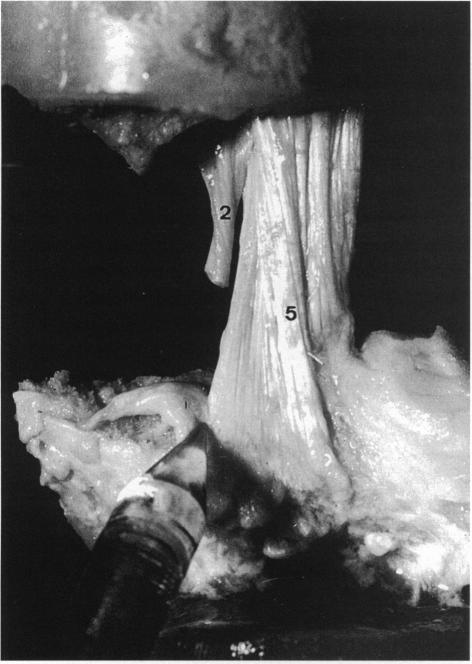
The cruciate ligaments of the knee consist of numerous fascicles, groups of which comprise fibre bundles. The stabilising function of these ligaments is established by changes in the lengths and orientations of the fascicles. Understanding the function of knee ligaments thus requires an understanding of their 3-dimensional fascicle architecture. Hitherto, the cruciate ligaments have been considered functionally as single-dimensional 'ropes' or, at the most, as consisting of anterior and posterior parts. It is evident from the appearance of these ligamentous structures, however, that fascicles in more than 2 directions are present. This study investigated how many and which fibre bundles are minimally needed to preserve the main fascicle directions in the ligaments. An anatomical analysis of the cruciate ligaments was performed using a 3-dimensional measuring device. Three anterior and 3 posterior cruciate ligaments were isolated and their fascicles measures. Based on the courses of the fascicles, fibre bundles were defined, dissected bluntly, and their corresponding insertion sites measured. Finally, the insertion sites of the bundles were connected into straight-line representations by a computer and transformed to the anatomical position of the knee, so as to be useful for functional analyses of the ligaments. It was found that 6-10 bundles are sufficient to represent the main fascicle directions of the ligaments. Although the number of fibre bundles is not identical for all ligaments, the femur and the tibia are connected in a consistent way by these bundles. Even the ways in which the fibre bundles change their interrelationship from the femoral to the tibial insertion sites are comparable. The results serve as a detailed anatomical basis for functional analyses of the cruciate ligaments.
膝关节的交叉韧带由许多束状结构组成,其中一些束状结构又包含纤维束。这些韧带的稳定功能是通过束状结构长度和方向的变化来实现的。因此,要理解膝关节韧带的功能,就需要了解其三维束状结构。迄今为止,交叉韧带在功能上一直被视为一维的“绳索”,或者最多被认为由前后两部分组成。然而,从这些韧带结构的外观可以明显看出,存在不止两个方向的束状结构。本研究调查了在韧带中最少需要多少束纤维以及哪些纤维束来保留主要的束状方向。使用三维测量设备对交叉韧带进行了解剖分析。分离出三条前交叉韧带和三条后交叉韧带,并测量了它们的束状结构。根据束状结构的走向,定义并钝性解剖纤维束,并测量其相应的附着点。最后,通过计算机将纤维束的附着点连接成直线表示,并转换到膝关节的解剖位置,以便用于韧带的功能分析。结果发现,6 - 10束纤维足以代表韧带的主要束状方向。虽然并非所有韧带的纤维束数量都相同,但这些纤维束以一致的方式连接股骨和胫骨。甚至纤维束从股骨附着点到胫骨附着点的相互关系变化方式也是可比的。这些结果为交叉韧带的功能分析提供了详细的解剖学基础。