Rojo E E, Stuart R A, Neupert W
Institut für Physiologische Chemie der Universität München, Germany.
EMBO J. 1995 Jul 17;14(14):3445-51. doi: 10.1002/j.1460-2075.1995.tb07350.x.
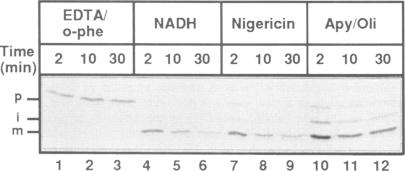
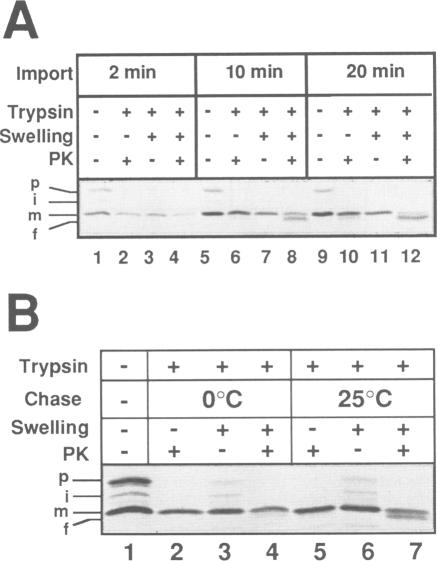
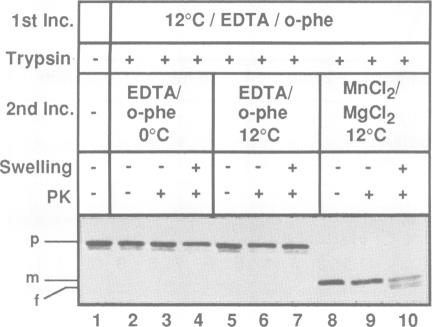
In an attempt to understand the mechanisms of sorting of mitochondrial inner membrane proteins, we have analyzed the import of subunit 9 of the mitochondrial F1F0-ATPase (Su9) from Neurospora crassa, an integral inner membrane protein. A chimeric protein was used consisting of the presequence and the first transmembrane domain of Su9 fused to mouse dihydrofolate reductase (preSu9(1-112)-DHFR). This protein attains the correct topology across the inner membrane (Nout-Cin) following import. The transmembrane domain becomes first completely imported into the matrix, where after processing of the presequence, it mediates membrane insertion and export of the N-terminal tail. Import and export steps can be experimentally dissected into two distinct events. Translocation of the N-terminal hydrophilic tail out of the matrix was blocked when the presequence was not processed, indicating an important role of the sequences and charges flanking the hydrophobic domain. Furthermore, export was supported by a delta pH and required matrix ATP hydrolysis. Thus the hydrophobic transmembrane domain operates as a membrane insertion signal and not as a stop-transfer signal. Our findings suggest that several aspects of this sorting process have been conserved from their prokaryotic ancestors.
为了了解线粒体内膜蛋白的分选机制,我们分析了粗糙脉孢菌线粒体F1F0 - ATP酶亚基9(Su9)的导入过程,Su9是一种内膜整合蛋白。我们使用了一种嵌合蛋白,它由Su9的前导序列和第一个跨膜结构域与小鼠二氢叶酸还原酶融合而成(preSu9(1 - 112)-DHFR)。导入后,该蛋白在内膜上获得了正确的拓扑结构(N端在外 - C端在内)。跨膜结构域首先完全导入基质,在前导序列加工后,它介导膜插入和N端尾巴的输出。导入和输出步骤可以通过实验分解为两个不同的事件。当未加工前导序列时,N端亲水尾巴从基质中的转运被阻断,这表明疏水结构域两侧的序列和电荷起着重要作用。此外,输出过程由质子动力势支持且需要基质ATP水解。因此,疏水跨膜结构域作为膜插入信号而非停止转运信号发挥作用。我们的研究结果表明,这种分选过程的几个方面与其原核祖先相比具有保守性。