Narita M, Bu G, Herz J, Schwartz A L
Edward Mallinckrodt Department of Pediatrics, Washington University School of Medicine, St. Louis, Missouri 63110, USA.
J Clin Invest. 1995 Aug;96(2):1164-8. doi: 10.1172/JCI118105.
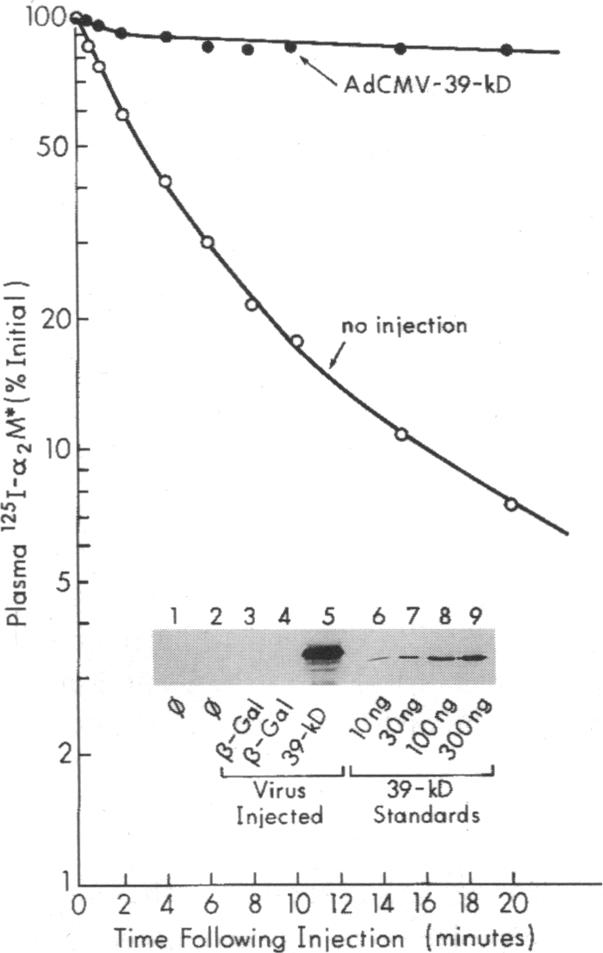
Tissue-type plasminogen activator (t-PA) is a serine protease, catalyzing the initial step in the fibrinolytic process. Intravenously administered t-PA is rapidly cleared from the circulation by the liver. Two distinct clearance mechanisms, which are mediated by the low density lipoprotein receptor-related protein (LRP) on liver parenchymal cells and by the mannose receptor on liver endothelial cells, have been described. Using competitors and inhibitors of the receptors, we investigated the role of LRP and carbohydrate receptors in t-PA clearance in vivo. To inhibit LRP, the 39-kD protein, which is a potent inhibitor of LRP activity, was overexpressed in the liver of mice using an adenoviral gene transfer technique. Expression of the 39-kD protein resulted in a sustained plasma concentration and an increase in the plasma half-life of 125I-t-PA from less than 1 min to 4-5 min. Blockade of the mannose receptor by intravenous administration of ovalbumin also prolonged the plasma half-life of 125I-t-PA to 3-4 min. The same degree of inhibition of t-PA clearance was also observed after administration of an inhibitor of the fucose receptor, fucosyl-BSA. However, under the conditions established for the complete blockade of the mannose receptor, no additional inhibition of t-PA clearance was observed using fucosyl-BSA, suggesting little or no role for the fucose receptor in the clearance of t-PA. Furthermore, a dramatic increase of the plasma half-life of 125I-t-PA (>> 20 min) was observed in mice overexpressing 39-kD protein and administered ovalbumin +/- fucosyl-BSA. Our results clearly demonstrate that two independent receptor systems, LRP and the mannose receptor, are involved in the hepatic clearance of t-PA.
组织型纤溶酶原激活剂(t-PA)是一种丝氨酸蛋白酶,催化纤维蛋白溶解过程的起始步骤。静脉注射的t-PA会被肝脏迅速从循环中清除。已经描述了两种不同的清除机制,它们分别由肝实质细胞上的低密度脂蛋白受体相关蛋白(LRP)和肝内皮细胞上的甘露糖受体介导。我们使用受体的竞争者和抑制剂,研究了LRP和碳水化合物受体在体内t-PA清除中的作用。为了抑制LRP,利用腺病毒基因转移技术在小鼠肝脏中过表达一种对LRP活性有强力抑制作用的39-kD蛋白。39-kD蛋白的表达导致血浆浓度持续升高,并且125I-t-PA的血浆半衰期从不到1分钟增加到4 - 5分钟。通过静脉注射卵清蛋白阻断甘露糖受体也使125I-t-PA的血浆半衰期延长至3 - 4分钟。在给予岩藻糖受体抑制剂岩藻糖基化牛血清白蛋白(fucosyl-BSA)后,也观察到了相同程度的t-PA清除抑制。然而,在建立了完全阻断甘露糖受体的条件下,使用岩藻糖基化牛血清白蛋白未观察到对t-PA清除的额外抑制,这表明岩藻糖受体在t-PA清除中作用很小或没有作用。此外,在过表达39-kD蛋白并给予卵清蛋白+/-岩藻糖基化牛血清白蛋白的小鼠中,观察到125I-t-PA的血浆半衰期急剧增加(>> 20分钟)。我们的结果清楚地表明,两个独立的受体系统,即LRP和甘露糖受体,参与了t-PA的肝脏清除。