Pilz D T, Dalton A, Long A, Jaspan T, Maltby E L, Quarrell O W
Centre for Human Genetics, Sheffield, UK.
J Med Genet. 1995 Apr;32(4):275-8. doi: 10.1136/jmg.32.4.275.
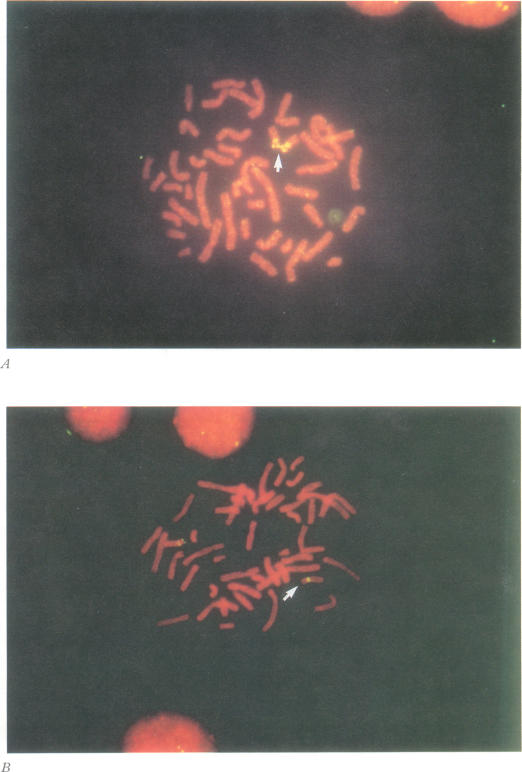
During a study of lissencephaly in England and Wales, 23 children were identified with this diagnosis. They were classified as follows: three children had Miller-Dieker syndrome (MDS), 13 had isolated lissencephaly sequence (ILS), two had type II lissencephaly, and five children were reclassified as focal or diffuse cortical dysplasia. Microdeletions of chromosome 17p13.3, also known as the Miller-Dieker critical region, have been associated with both MDS and ILS. We used the commercially available Oncor probe for fluorescent in situ hybridisation (FISH) studies on 14 patients and a further four were studied elsewhere. Deletions were identified in all three MDS patients and two of the ILS patients. These results are consistent with previously reported data. No deletions were found in those patients with focal or diffuse cortical dysplasia. In addition, a CA repeat polymorphism which maps to the Miller-Dieker critical region was studied in 12 families and was informative in nine; the results were consistent with the FISH data. We conclude that FISH is a reliable method to detect deletions in patients with MDS and ILS and also useful to identify chromosome rearrangements in their parents which are not detected by conventional cytogenetic analysis. The PCR assay, if informative, is also reliable and a useful alternative if only DNA is available. None of the five children with atypical radiological features had a deletion. We therefore suggest that as well as looking for other aetiologies a careful review of the diagnosis should be made of the MDS or ILS cases in whom a deletion is not found.
在对英格兰和威尔士的无脑回畸形进行的一项研究中,确诊了23名患有该病症的儿童。他们被分类如下:3名儿童患有米勒 - 迪克尔综合征(MDS),13名患有孤立性无脑回序列(ILS),2名患有II型无脑回畸形,5名儿童被重新分类为局灶性或弥漫性皮质发育异常。17号染色体短臂13.3区域的微缺失,也被称为米勒 - 迪克尔关键区域,与MDS和ILS均有关联。我们使用市售的Oncor探针进行荧光原位杂交(FISH)研究,对14名患者进行了检测,另有4名患者在其他地方进行了研究。在所有3名MDS患者和2名ILS患者中均发现了缺失。这些结果与先前报道的数据一致。在那些患有局灶性或弥漫性皮质发育异常的患者中未发现缺失。此外,对12个家庭中定位到米勒 - 迪克尔关键区域的CA重复多态性进行了研究,其中9个家庭的结果具有参考价值;结果与FISH数据一致。我们得出结论,FISH是检测MDS和ILS患者缺失的可靠方法,对于识别其父母中常规细胞遗传学分析未检测到的染色体重排也很有用。如果具有参考价值,PCR检测也是可靠的,并且在仅可获得DNA时是一种有用的替代方法。5名具有非典型放射学特征的儿童均未出现缺失。因此,我们建议除了寻找其他病因外,对于未发现缺失的MDS或ILS病例,应仔细重新审查诊断。