Goureau O, Lepoivre M, Becquet F, Courtois Y
Unité de Recherches Gérontologiques, Institut National de la Santé et de la Recherche Médicale U118, Paris, France.
Proc Natl Acad Sci U S A. 1993 May 1;90(9):4276-80. doi: 10.1073/pnas.90.9.4276.
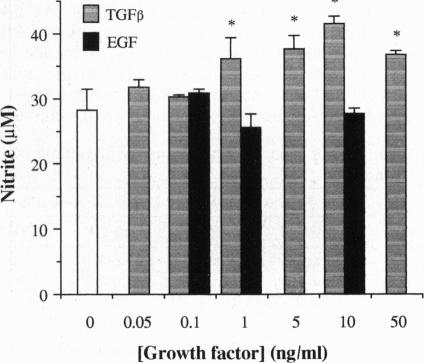
Bovine retinal pigmented epithelial (RPE) cells express, after activation with interferon gamma (IFN-gamma) and lipopolysaccharide (LPS), an inducible nitric oxide synthase (NOS). Experiments were done to investigate the effects of the transforming growth factor beta 1, epidermal growth factor, and fibroblast growth factors (FGFs), which are abundant in the retina, on NOS activity. Transforming growth factor beta 1 slightly increases the production of nitrite, an oxidation product of NO, induced by LPS plus IFN-gamma, whereas acidic and basic FGFs markedly inhibit the nitrite release due to LPS/IFN-gamma in a concentration-dependent manner, and epidermal growth factor did not modify LPS/IFN-gamma-induced NOS activity. The growth factors alone did not stimulate nitrite release. We have attempted to elucidate the mechanism of FGF inhibition. Results with heparin, suramin, and tyrphostin suggest involvement of the high-affinity receptor for FGF in its inhibition of LPS/IFN-gamma-stimulated NOS activity. Continued stimulation of RPE cells with LPS/IFN-gamma was essential for the induction of NO synthesis, and maximal inhibition was obtained when FGF was present during stimulation with LPS/IFN-gamma, suggesting that FGF inhibits NOS induction. Furthermore, an antiproliferative action of NO was demonstrated by an inverse correlation between the amounts of nitrite or citrulline produced in response to different stimuli (LPS/IFN-gamma or LPS/IFN-gamma with growth factors) and the level of cellular proliferation. Similar inhibition of growth was obtained when RPE cells were incubated with an NO donor, sydnonimide. Because NO acts as a cytotoxic compound in the retina, FGF, by inhibiting the induction of NOS in RPE cells, may have beneficial effects in protecting the retina from cytokine and endotoxin-mediated tissue damage.
牛视网膜色素上皮(RPE)细胞在用γ干扰素(IFN-γ)和脂多糖(LPS)激活后,会表达一种诱导型一氧化氮合酶(NOS)。开展实验以研究视网膜中大量存在的转化生长因子β1、表皮生长因子和成纤维细胞生长因子(FGFs)对NOS活性的影响。转化生长因子β1会轻微增加由LPS加IFN-γ诱导产生的亚硝酸盐(NO的氧化产物)的生成量,而酸性和碱性FGFs会以浓度依赖的方式显著抑制由LPS/IFN-γ导致的亚硝酸盐释放,并且表皮生长因子不会改变LPS/IFN-γ诱导的NOS活性。单独的生长因子不会刺激亚硝酸盐释放。我们试图阐明FGF抑制的机制。肝素、苏拉明和酪氨酸磷酸化抑制剂的实验结果表明FGF的高亲和力受体参与了其对LPS/IFN-γ刺激的NOS活性的抑制作用。用LPS/IFN-γ持续刺激RPE细胞对于诱导NO合成至关重要,并且当在LPS/IFN-γ刺激期间存在FGF时可获得最大抑制效果,这表明FGF抑制NOS诱导。此外,通过响应不同刺激(LPS/IFN-γ或LPS/IFN-γ与生长因子)产生的亚硝酸盐或瓜氨酸量与细胞增殖水平之间的负相关,证明了NO的抗增殖作用。当RPE细胞与NO供体西多尼明一起孵育时,也获得了类似的生长抑制效果。由于NO在视网膜中作为一种细胞毒性化合物起作用,FGF通过抑制RPE细胞中NOS的诱导,可能在保护视网膜免受细胞因子和内毒素介导的组织损伤方面具有有益作用。