Palkama T, Majuri M L, Mattila P, Hurme M, Renkonen R
Department of Bacteriology and Immunology, University of Helsinki, Finland.
Clin Exp Immunol. 1993 May;92(2):353-60. doi: 10.1111/j.1365-2249.1993.tb03404.x.
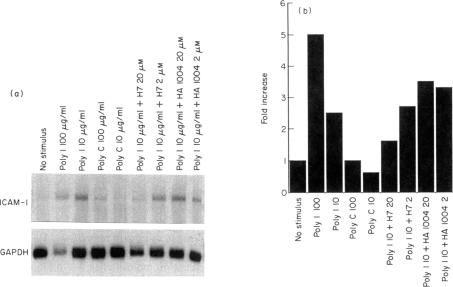
Monocyte adherence to the endothelium, their penetration to the subendothelial space and excessive lipid accumulation (foam cell formation) are the initial events in atherogenesis. Scavenger receptors have been reported to play an important role in foam cell formation, since modified low density lipoproteins can be taken up via scavenger receptors in a non-down-regulated fashion. In this study we demonstrate that stimulation of scavenger receptors in endothelial cells induces the expression of endothelial adhesion molecules. Polyinosinic acid (poly I), a known scavenger receptor ligand, significantly induced the expression of intercellular adhesion molecule-1 (ICAM-1), vascular cell adhesion molecule-1 (VCAM-1) and E-selectin on human umbilical vein endothelial cells when compared with polycytidylic acid (poly C), a structurally related compound to poly I, which does not bind to the scavenger receptor. The effect of scavenger receptor ligands on the endothelial cell line EA hy. 926 was also tested. Poly I up-regulated ICAM-1 expression also on EA hy. 926 cells, while it had no effect on IL-1 beta or tumour necrosis factor-alpha (TNF-alpha) production on the same cell line. Poly I-induced ICAM-1 expression on EA hy. 926 cells could be inhibited by H7, a protein kinase C inhibitor, while HA 1004, a preferential protein kinase A inhibitor, had no effect on ICAM-1 expression. The role of protein kinase C in scavenger receptor-mediated adhesion molecule upregulation was confirmed by the ability of poly I to directly activate protein kinase C, when measured with 3H-phorbol dibutyrate binding to EA hy. 926 cells, while poly C again was ineffective.
单核细胞黏附于内皮,穿透至内皮下间隙并过度脂质蓄积(形成泡沫细胞)是动脉粥样硬化发生的起始事件。据报道,清道夫受体在泡沫细胞形成中起重要作用,因为修饰的低密度脂蛋白可通过清道夫受体以非下调方式被摄取。在本研究中,我们证明内皮细胞中清道夫受体的刺激可诱导内皮黏附分子的表达。聚肌苷酸(poly I)是一种已知的清道夫受体配体,与结构相关但不与清道夫受体结合的聚胞苷酸(poly C)相比,它能显著诱导人脐静脉内皮细胞上细胞间黏附分子-1(ICAM-1)、血管细胞黏附分子-1(VCAM-1)和E-选择素的表达。还测试了清道夫受体配体对内皮细胞系EA hy. 926的作用。Poly I也上调了EA hy. 926细胞上ICAM-1的表达,而对同一细胞系中白细胞介素-1β或肿瘤坏死因子-α(TNF-α)的产生没有影响。蛋白激酶C抑制剂H7可抑制Poly I诱导的EA hy. 926细胞上ICAM-1的表达,而优先的蛋白激酶A抑制剂HA 1004对ICAM-1的表达没有影响。当用3H-佛波醇二丁酸酯与EA hy. 926细胞结合来测量时,poly I直接激活蛋白激酶C的能力证实了蛋白激酶C在清道夫受体介导的黏附分子上调中的作用,而poly C同样无效。