Bahouth S W
Department of Pharmacology, College of Medicine, University of Tennessee, Memphis 38163, USA.
Biochem J. 1995 May 1;307 ( Pt 3)(Pt 3):831-41. doi: 10.1042/bj3070831.
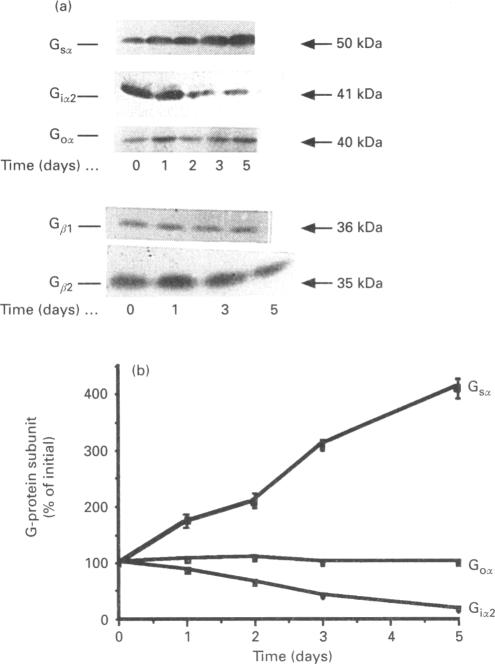
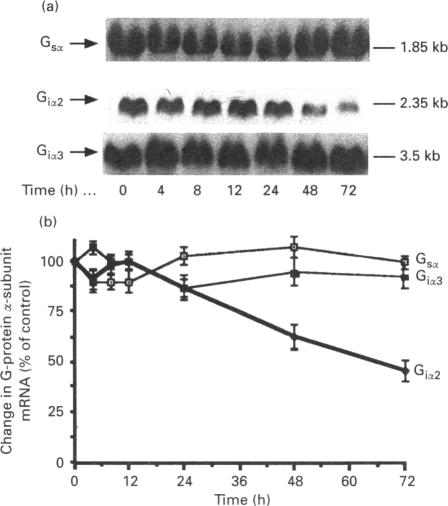
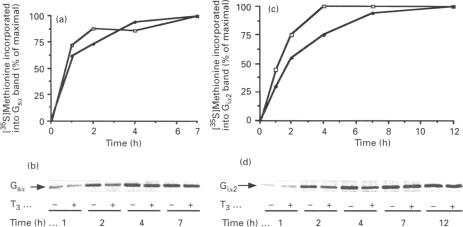
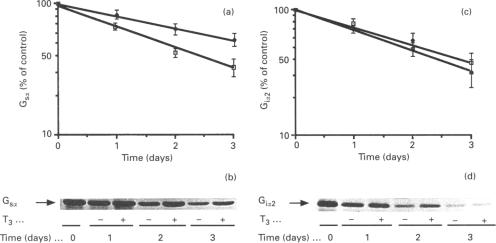
Thyroid hormone exerts profound effects on the activity of the hormone-sensitive adenylate cyclase system in the heart. Distinct guanine nucleotide-binding regulatory proteins (G-proteins) mediate stimulatory and inhibitory influences on adenylate cyclase activity. To examine whether the effects of thyroid hormone on adenylate cyclase involve specific changes in G-protein subunit expression, the influence of tri-iodothyronine (T3) on the biosynthesis and activity of G-proteins in neonatal rat ventricular myocytes was determined. In myocytes challenged with T3 for 5 days, Gs alpha levels increased by 4 +/- 0.5-fold, whereas Gi2 alpha levels declined by more than 80%. T3 down-regulated Gi2 alpha mRNA by 60% within 3 days, but had no effect on Gs alpha mRNA. The basis for the decline in Gi2 alpha mRNA was the T3-mediated suppression of Gi2 alpha gene transcription by 80 +/- 9% within 4 h. The decline in Gi2 alpha mRNA in response to T3 produced a 2-fold decrease in relative rate of synthesis of Gi2 alpha but not in its half-life (46 +/- 7 h). Gs alpha synthesis was not altered by T3, but the half-life of Gs alpha increased from 50 +/- 6 h in control cells to 72 +/- 8 h in T3-treated cells. In addition, T3 provoked the translocation of Gs alpha from the cytoplasmic to the membranous compartment. Membranous Gs alpha increased from 30 +/- 6% to 61 +/- 7% of total cellular Gs alpha, whereas cytoplasmic Gs alpha declined from 68 +/- 6% to 33 +/- 8% within 1 day of exposure to T3. T3-mediated up-regulation of Gs alpha enhanced the activation of myocardial adenylate cyclase by the stimulatory pathway whereas the down-regulation of Gi2 alpha attenuated the deactivation of myocardial adenylate cyclase by the inhibitory pathway.
甲状腺激素对心脏中激素敏感型腺苷酸环化酶系统的活性具有深远影响。不同的鸟嘌呤核苷酸结合调节蛋白(G蛋白)介导对腺苷酸环化酶活性的刺激和抑制作用。为了研究甲状腺激素对腺苷酸环化酶的影响是否涉及G蛋白亚基表达的特定变化,测定了三碘甲状腺原氨酸(T3)对新生大鼠心室肌细胞中G蛋白生物合成和活性的影响。在用T3刺激5天的肌细胞中,Gsα水平增加了4±0.5倍,而Gi2α水平下降了80%以上。T3在3天内使Gi2α mRNA下调60%,但对Gsα mRNA无影响。Gi2α mRNA下降的原因是T3在4小时内介导Gi2α基因转录抑制80±9%。T3引起的Gi2α mRNA下降使Gi2α的相对合成速率降低了2倍,但半衰期未改变(46±7小时)。T3未改变Gsα的合成,但Gsα的半衰期从对照细胞中的50±6小时增加到T3处理细胞中的72±8小时。此外,T3促使Gsα从细胞质向膜区室移位。在暴露于T3的1天内,膜Gsα从细胞总Gsα的30±6%增加到61±7%,而细胞质Gsα从68±6%下降到33±8%。T3介导的Gsα上调增强了刺激途径对心肌腺苷酸环化酶的激活,而Gi2α的下调减弱了抑制途径对心肌腺苷酸环化酶的失活作用。