Sechi L A, Valentin J P, Griffin C A, Lee E, Bartoli E, Humphreys M H, Schambelan M
Department of Internal Medicine, University of Udine, Italy.
J Clin Invest. 1995 Jun;95(6):2451-7. doi: 10.1172/JCI117945.
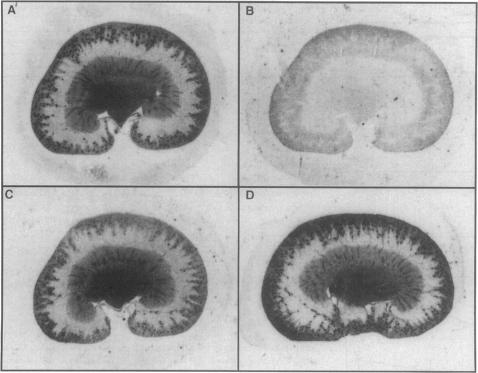
To determine whether decreased renal responsiveness to atrial natriuretic peptide (ANP) in diabetes is mediated by alterations in the renal ANP receptor, ANP receptor density and affinity were measured 17-20 d after streptozotocin injection and compared with values in vehicle-treated controls and streptozotocin-treated rats made euglycemic with insulin. Plasma ANP concentration was significantly greater in hyperglycemic diabetic rats than in control or euglycemic diabetic rats. Both in glomeruli and inner medulla, ANP receptor dissociation constant did not differ among the three study groups, whereas the maximum binding capacity was decreased significantly in hyperglycemic diabetics in comparison with controls and euglycemic diabetics. Glomerular clearance receptors were also decreased significantly in hyperglycemic diabetic rats in comparison with control and euglycemic diabetic rats. To determine whether the decreased number of renal ANP receptors in diabetic rats was associated with a decreased biological response, we measured ANP-dependent cyclic GMP (cGMP) accumulation by isolated glomeruli and inner medullary collecting duct cells in vitro. cGMP accumulation was significantly less in hyperglycemic diabetic rats than in controls or euglycemic diabetic rats both in the presence or absence of the phosphodiesterase inhibitor zaprinast. cGMP phosphodiesterase activity in inner medullary collecting duct cells obtained from control and hyperglycemic diabetic rats did not differ. Thus, the decreased number of biologically active ANP receptors in the kidneys of diabetic rats is accompanied by decreased biological responsiveness in vitro and provides a potential explanation for the reduction in renal sensitivity to ANP in this condition.
为了确定糖尿病时肾脏对心房利钠肽(ANP)反应性降低是否由肾脏ANP受体改变介导,在链脲佐菌素注射后17 - 20天测量ANP受体密度和亲和力,并与溶剂处理的对照大鼠以及用胰岛素使血糖正常的链脲佐菌素处理大鼠的值进行比较。高血糖糖尿病大鼠的血浆ANP浓度显著高于对照或血糖正常的糖尿病大鼠。在肾小球和髓质内层,三个研究组之间的ANP受体解离常数没有差异,而与对照和血糖正常的糖尿病大鼠相比,高血糖糖尿病大鼠的最大结合能力显著降低。与对照和血糖正常的糖尿病大鼠相比,高血糖糖尿病大鼠的肾小球清除受体也显著减少。为了确定糖尿病大鼠肾脏ANP受体数量减少是否与生物反应性降低有关,我们在体外测量了分离的肾小球和髓质内层集合管细胞中ANP依赖性环磷酸鸟苷(cGMP)的积累。无论有无磷酸二酯酶抑制剂扎普司特,高血糖糖尿病大鼠的cGMP积累均显著低于对照或血糖正常的糖尿病大鼠。从对照和高血糖糖尿病大鼠获得的髓质内层集合管细胞中的cGMP磷酸二酯酶活性没有差异。因此,糖尿病大鼠肾脏中生物活性ANP受体数量减少伴随着体外生物反应性降低,并为这种情况下肾脏对ANP敏感性降低提供了一个潜在的解释。