Bouton M C, Jandrot-Perrus M, Moog S, Cazenave J P, Guillin M C, Lanza F
Laboratoire de Recherche sur l'Hémostase et la Thrombose, Faculté Xavier Bichat, Paris, France.
Biochem J. 1995 Jan 15;305 ( Pt 2)(Pt 2):635-41. doi: 10.1042/bj3050635.
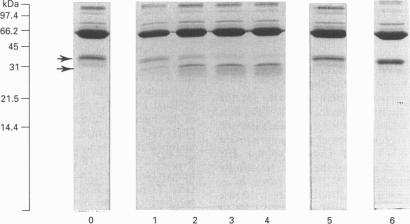
The cDNA of the human endothelial cell thrombin receptor has been cloned and a chimeric fusion protein consisting of glutathione-S-transferase (GST) and the portion 25-97 corresponding to the N-terminal first extracellular domain of the thrombin receptor (TRE) has been expressed in Escherichia coli. Introduction of a factor Xa cleavage site in the fusion protein allowed purification of TRE after removal from the GST carrier protein. Purified GST-TRE or TRE have been tested in solution for their ability to interact with thrombin. alpha-Thrombin cleaved the fusion protein at position Arg-41-Ser-42 of TRE in a time- and concentration-dependent manner and GST-TRE competed with the tripeptidic substrate S-2238 for hydrolysis by thrombin (Ki = 0.5 microM). gamma-Thrombin that lacks the anion-binding exosite was 100-fold less potent than alpha-thrombin at cleaving GST-TRE. TRE competed with polymerizing fibrin monomers for binding to thrombin (Ki = 7.5 microM). The cleavage of GST-TRE by alpha-thrombin was inhibited by several alpha-thrombin exosite ligands such as the C-terminal peptide of hirudin, thrombomodulin and fibrin(ogen) fragment E. In contrast, platelet glycocalicin did not inhibit GST-TRE cleavage. In conclusion, the use of purified soluble GST-TRE allowed us to derive an affinity constant for thrombin interaction with the N-terminal domain of the receptor and to confirm the location of the cleavage site at Arg41-Ser-42 of the receptor. The importance of the thrombin anion-binding exosite for thrombin receptor recognition is highlighted by the low reactivity of gamma-thrombin for GST-TRE and by competition experiments, which in addition indicate that binding sites for fibrin(ogen), thrombomodulin and GST-TRE are overlapping. In contrast, binding of thrombin to GST-TRE and glycocalicin are not mutually exclusive, indicating that glycocalicin and TRE interact with discrete subsites within the large groove that constitutes the anion-binding exosite.
人内皮细胞凝血酶受体的cDNA已被克隆,一种由谷胱甘肽-S-转移酶(GST)和凝血酶受体(TRE)N端第一个细胞外结构域对应的25-97部分组成的嵌合融合蛋白已在大肠杆菌中表达。在融合蛋白中引入因子Xa切割位点,使得从GST载体蛋白上切下后能够纯化TRE。已对纯化的GST-TRE或TRE在溶液中与凝血酶相互作用的能力进行了测试。α-凝血酶以时间和浓度依赖的方式在TRE的Arg-41-Ser-42位点切割融合蛋白,并且GST-TRE与三肽底物S-2238竞争被凝血酶水解(Ki = 0.5 microM)。缺乏阴离子结合外位点的γ-凝血酶在切割GST-TRE时的效力比α-凝血酶低100倍。TRE与聚合的纤维蛋白单体竞争结合凝血酶(Ki = 7.5 microM)。α-凝血酶对GST-TRE的切割受到几种α-凝血酶外位点配体的抑制,如水蛭素的C端肽、血栓调节蛋白和纤维蛋白(原)片段E。相反,血小板糖蛋白不抑制GST-TRE的切割。总之,使用纯化的可溶性GST-TRE使我们能够得出凝血酶与受体N端结构域相互作用的亲和常数,并确认受体在Arg41-Ser-42处的切割位点位置。γ-凝血酶对GST-TRE的低反应性以及竞争实验突出了凝血酶阴离子结合外位点对凝血酶受体识别的重要性,竞争实验还表明纤维蛋白(原)、血栓调节蛋白和GST-TRE的结合位点相互重叠。相反,凝血酶与GST-TRE和糖蛋白的结合并非相互排斥,这表明糖蛋白和TRE与构成阴离子结合外位点的大沟内的离散亚位点相互作用。