Zhou Q, Sharp P A
Center for Cancer Research, Massachusetts Institute of Technology, Cambridge 02139.
EMBO J. 1995 Jan 16;14(2):321-8. doi: 10.1002/j.1460-2075.1995.tb07006.x.
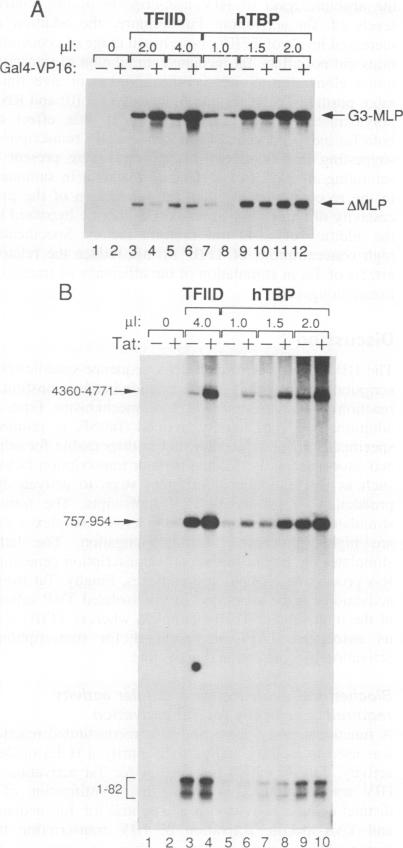
Tat regulation of human immunodeficiency virus (HIV) transcription is unique because of its specificity for an RNA target, TAR, and its ability to increase the efficiency of elongation by polymerase. A reconstituted reaction that is Tat-specific and TAR-dependent for activation of HIV transcription has been used to identify and partially purify a cellular activity that is required for trans-activation by Tat, but not by other activators. In the reaction, Tat stimulates the efficiency of elongation by polymerase, whereas Sp1 and other DNA sequence-specific transcription factors activate the rate of initiation. Furthermore, while TATA binding protein (TBP)-associated factors (TAFs) in the TFIID complex are required for activation by transcription factors, they are dispensable for Tat function. Thus, Tat acts through a novel mechanism, which is mediated by a specific host cellular factor, to stimulate HIV-1 gene expression.
人类免疫缺陷病毒(HIV)转录的Tat调节具有独特性,这是因为它对RNA靶标TAR具有特异性,并且能够提高聚合酶的延伸效率。一种对HIV转录激活具有Tat特异性和TAR依赖性的重组反应已被用于鉴定和部分纯化一种细胞活性,这种活性是Tat反式激活所必需的,但其他激活因子则不需要。在该反应中,Tat刺激聚合酶的延伸效率,而Sp1和其他DNA序列特异性转录因子激活起始速率。此外,虽然TFIID复合物中的TATA结合蛋白(TBP)相关因子(TAFs)是转录因子激活所必需的,但它们对于Tat功能是可有可无的。因此,Tat通过一种由特定宿主细胞因子介导的新机制来刺激HIV-1基因表达。