Zietkiewicz E, Richer C, Makalowski W, Jurka J, Labuda D
Hôpital Ste-Justine, Département de Pédiatrie, Université de Montréal, Québec, Canada.
Nucleic Acids Res. 1994 Dec 25;22(25):5608-12. doi: 10.1093/nar/22.25.5608.
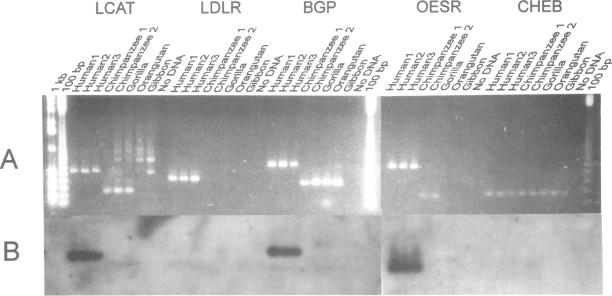
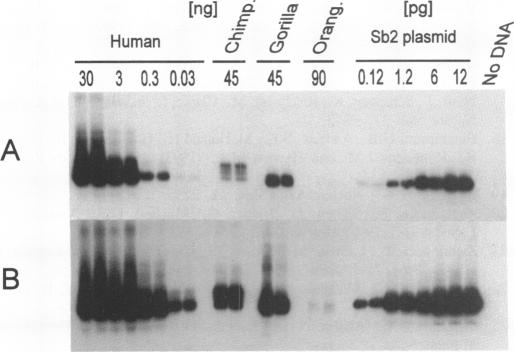
A variety of Alu subfamilies amplified in primate genomes at different evolutionary time periods. Alu Sb2 belongs to a group of young subfamilies with a characteristic two-nucleotide deletion at positions 65/66. It consists of repeats having a 7-nucleotide duplication of a sequence segment involving positions 246 through 252. The presence of Sb2 inserts was examined in five genomic loci in 120 human DNA samples as well as in DNAs of higher primates. The lack of the insertional polymorphism seen at four human loci and the absence of orthologous inserts in apes indicated that the examined repeats retroposed early in the human lineage, but following the divergence of great apes. On the other hand, similar analysis of the fifth locus (butyrylcholinesterase gene) suggested contemporary retropositional activity of this subfamily. By a semi-quantitative PCR, using a primer pair specific for Sb2 repeats, we estimated their copy number at about 1500 per human haploid genome; the corresponding numbers in chimpanzee and gorilla were two orders of magnitude lower, while in orangutan and gibbon the presence of Sb2 Alu was hardly detectable. Sequence analysis of PCR-amplified Sb2 repeats from human and African great apes is consistent with the model in which the founding of Sb2 subfamily variants occurred independently in chimpanzee, gorilla and human lineages.
多种Alu亚家族在不同的进化时期在灵长类基因组中扩增。Alu Sb2属于一组年轻的亚家族,在65/66位具有特征性的两核苷酸缺失。它由涉及246至252位的序列片段的7核苷酸重复组成。在120个人类DNA样本以及高等灵长类动物的DNA中的五个基因组位点检测了Sb2插入的存在。在四个人类位点未见插入多态性以及在猿类中没有直系同源插入表明所检测的重复序列在人类谱系中早期逆转座,但在大猩猩分化之后。另一方面,对第五个位点(丁酰胆碱酯酶基因)的类似分析表明该亚家族具有当代逆转座活性。通过使用对Sb2重复序列特异的引物对进行半定量PCR,我们估计其在每个人类单倍体基因组中的拷贝数约为1500;黑猩猩和大猩猩中的相应数量低两个数量级,而在猩猩和长臂猿中几乎检测不到Sb2 Alu的存在。对来自人类和非洲大猩猩的PCR扩增的Sb2重复序列的序列分析与以下模型一致,即Sb2亚家族变体的建立在黑猩猩、大猩猩和人类谱系中独立发生。