Ferkol T, Perales J C, Eckman E, Kaetzel C S, Hanson R W, Davis P B
Department of Pediatrics, Rainbow Babies and Childrens Hospital, Cleveland, Ohio.
J Clin Invest. 1995 Feb;95(2):493-502. doi: 10.1172/JCI117690.
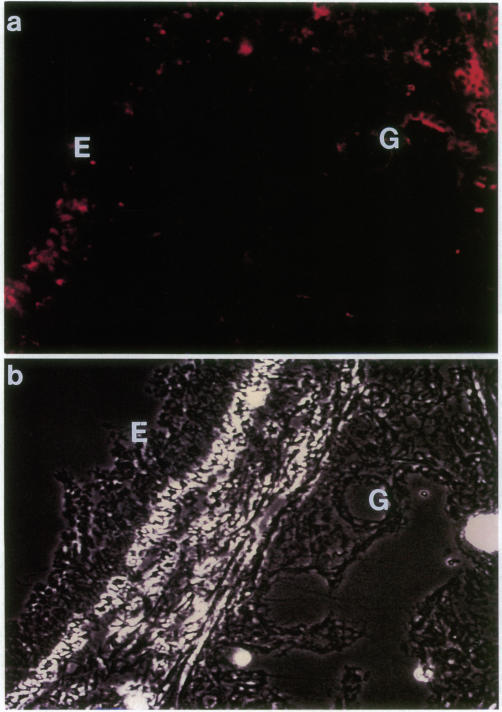
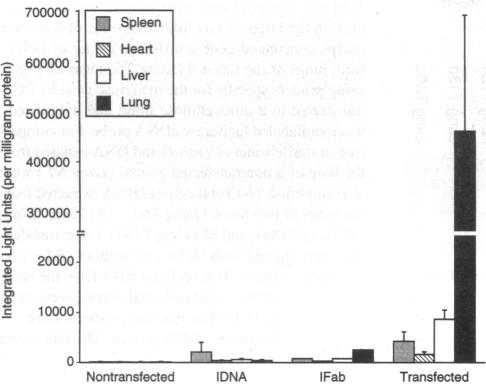
Genes of interest can be targeted specifically to respiratory epithelial cells in intact animals with high efficiency by exploiting the receptor-mediated endocytosis of the polymeric immunoglobulin receptor. A DNA carrier, consisting of the Fab portion of polyclonal antibodies raised against rat secretory component covalently linked to poly-L-lysine, was used to introduce plasmids containing different reporter genes into airway epithelial cells in vivo. We observed significant levels of luciferase enzyme activity in protein extracts from the liver and lung, achieving maximum values of 13,795 +/- 4,431 and 346,954 +/- 199,120 integrated light units (ILU) per milligram of protein extract, respectively. No luciferase activity was detected in spleen or heart, which do not express the receptor. Transfections using complexes consisting of an irrelevant plasmid (pCMV lacZ) bound to the bona fide carrier or the expression plasmid (pGEMluc) bound to a carrier based on an irrelevant Fab fragment resulted in background levels of luciferase activity in all tissues examined. Thus, only tissues that contain cells bearing the polymeric immunoglobulin receptor are transfected, and transfection cannot be attributed to the nonspecific uptake of an irrelevant carrier-DNA complex. Specific mRNA from the luciferase gene was also detected in the lungs of transfected animals. To determine which cells in the lungs are transfected by this method, DNA complexes were prepared containing expression plasmids with genes encoding the bacterial beta-galactosidase or the human interleukin 2 receptor. Expression of these genes was localized to the surface epithelium of the airways and the submucosal glands, and not the bronchioles and alveoli. Receptor-mediated endocytosis can be used to introduce functional genes into the respiratory epithelium of rats, and may be a useful technique for gene therapy targeting the lung.
通过利用聚合免疫球蛋白受体的受体介导的内吞作用,可将感兴趣的基因高效、特异地靶向完整动物的呼吸道上皮细胞。使用一种DNA载体,其由针对大鼠分泌成分产生的多克隆抗体的Fab部分与聚-L-赖氨酸共价连接组成,用于在体内将含有不同报告基因的质粒导入气道上皮细胞。我们在肝脏和肺的蛋白质提取物中观察到显著水平的荧光素酶活性,每毫克蛋白质提取物分别达到13,795±4,431和346,954±199,120积分光单位(ILU)的最大值。在不表达该受体的脾脏或心脏中未检测到荧光素酶活性。使用由与真正载体结合的无关质粒(pCMV lacZ)或与基于无关Fab片段的载体结合的表达质粒(pGEMluc)组成的复合物进行转染,在所有检测的组织中均产生了荧光素酶活性的背景水平。因此,只有含有携带聚合免疫球蛋白受体细胞的组织才会被转染,且转染不能归因于无关载体-DNA复合物的非特异性摄取。在转染动物的肺中也检测到了来自荧光素酶基因的特异性mRNA。为了确定肺中哪些细胞通过这种方法被转染,制备了含有编码细菌β-半乳糖苷酶或人白细胞介素2受体基因的表达质粒的DNA复合物。这些基因的表达定位于气道的表面上皮和黏膜下腺,而非细支气管和肺泡。受体介导的内吞作用可用于将功能基因导入大鼠的呼吸道上皮,可能是一种针对肺部的基因治疗有用技术。