Lee Y, Erkine A M, Van Ryk D I, Nazar R N
Department of Molecular Biology and Genetics, University of Guelph, Ontario, Canada.
Nucleic Acids Res. 1995 Feb 25;23(4):634-40. doi: 10.1093/nar/23.4.634.
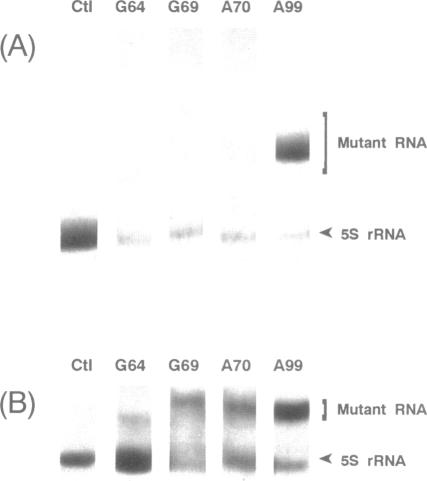
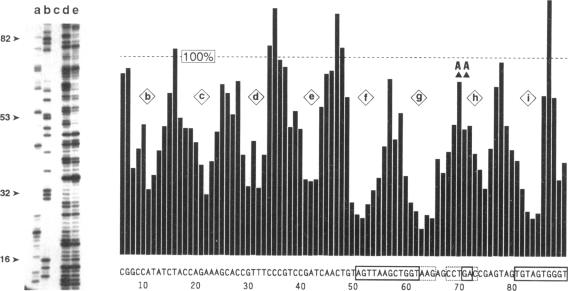
The internal control region of the Saccharomyces cerevisiae 5S rRNA gene has been characterized in vivo by genomic DNase I footprinting and by mutational analyses using base substitutions, deletions or insertions. A high copy shuttle vector was used to efficiently express mutant 5S rRNA genes in vivo and isotope labelling kinetics were used to distinguish impeded gene expression from nascent RNA degradation. In contrast to mutational studies in reconstituted systems, the analyses describe promoter elements which closely resemble the three distinct sequence elements that have been observed in Xenopus laevis 5S rRNA. The results indicate a more highly conserved structure than previously reported with reconstituted systems and suggest that the saturated conditions which are used in reconstitution studies mask sequence dependence which may be physiologically significant. Footprint analyses support the extended region of protein interaction which has recently been observed in some reconstituted systems, but mutational analyses indicate that these interactions are not sequence specific. Periodicity in the footprint provides further detail regarding the in vivo topology of the interacting protein.
酿酒酵母5S rRNA基因的内部控制区域已通过基因组DNA酶I足迹法以及使用碱基替换、缺失或插入的突变分析在体内进行了表征。使用高拷贝穿梭载体在体内有效表达突变型5S rRNA基因,并利用同位素标记动力学来区分受阻的基因表达与新生RNA降解。与重组系统中的突变研究相反,这些分析描述了启动子元件,它们与在非洲爪蟾5S rRNA中观察到的三个不同序列元件非常相似。结果表明,其结构比之前重组系统报道的更为保守,这表明重组研究中使用的饱和条件掩盖了可能具有生理意义的序列依赖性。足迹分析支持了最近在一些重组系统中观察到的蛋白质相互作用扩展区域,但突变分析表明这些相互作用不是序列特异性的。足迹中的周期性提供了关于相互作用蛋白质体内拓扑结构的更多细节。