Wikler K C, Rakic P
Section of Neurobiology, Yale University School of Medicine, New Haven, CT 06510.
Proc Natl Acad Sci U S A. 1994 Jul 5;91(14):6534-8. doi: 10.1073/pnas.91.14.6534.
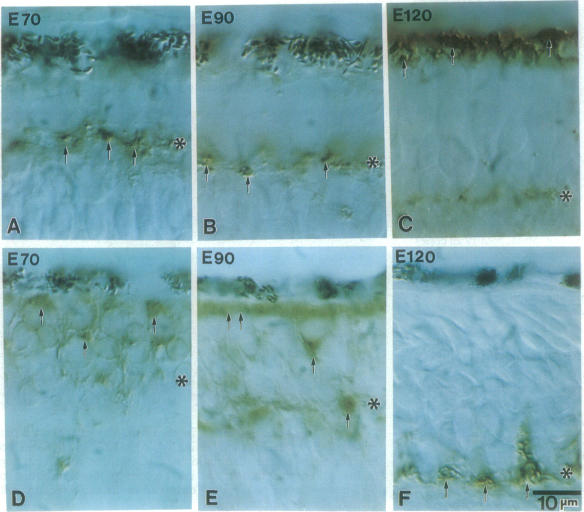
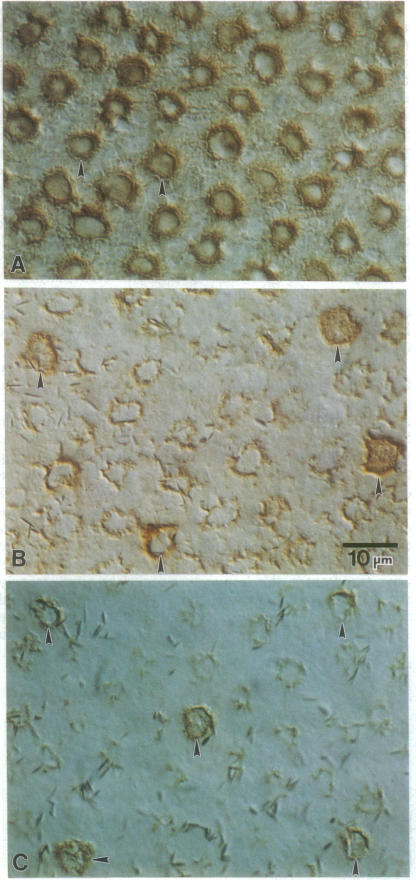
We previously have demonstrated that approximately 10% of cones in the fetal monkey retina precociously express the red/green opsin. These data suggested the possibility that a subset of cones differentiates prior to their nascent cone neighbors. To further assess this early cone differentiation in the fetal monkey retina, we used monoclonal antibodies proven to be important developmental markers of photoreceptor phenotypes and synaptogenesis (XAP-1, specific to photoreceptor membranes; SV2, specific to synaptic vesicle protein). Although these two antibodies recognize functionally distinct antigens, our analyses revealed that both identify a subset of precociously immunoreactive cones. Further, XAP-1- and SV2-positive cones are distributed in the same pattern as precocious red/green-sensitive cones in immature regions of the fetal monkey retina. These results support the hypothesis that the primate retina possesses a spatially organized protomap that may induce the emergence of the photoreceptor mosaic and trigger the formation of color-specific pathways that include horizontal, bipolar, and retinal ganglion cells.
我们之前已经证明,胎猴视网膜中约10%的视锥细胞过早地表达红/绿视蛋白。这些数据表明,一部分视锥细胞可能在其新生的视锥细胞邻居之前就已分化。为了进一步评估胎猴视网膜中这种早期视锥细胞分化情况,我们使用了经证实是光感受器表型和突触形成重要发育标志物的单克隆抗体(XAP-1,对光感受器膜具有特异性;SV2,对突触小泡蛋白具有特异性)。尽管这两种抗体识别功能不同的抗原,但我们的分析表明,它们都能识别一部分过早出现免疫反应的视锥细胞。此外,XAP-1和SV2阳性视锥细胞在胎猴视网膜未成熟区域的分布模式与过早出现的红/绿敏感视锥细胞相同。这些结果支持了这样一种假说,即灵长类动物视网膜拥有一个空间组织化的原图谱,该图谱可能诱导光感受器镶嵌的出现,并触发包括水平细胞、双极细胞和视网膜神经节细胞在内的颜色特异性通路的形成。