Whitehouse R W, Batterbury M, Jackson A, Noble J L
Department of Clinical Radiology, Manchester Royal Infirmary.
Br J Ophthalmol. 1994 Aug;78(8):618-20. doi: 10.1136/bjo.78.8.618.
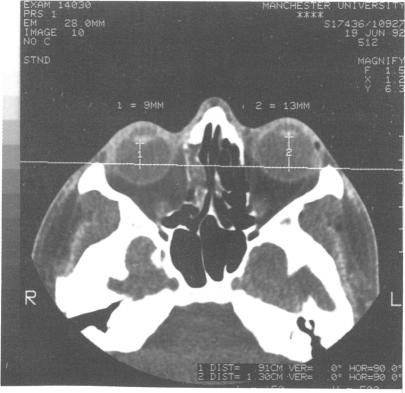
In 11 patients with blow out fracture of the orbit, measurement of orbital volume using computed tomography (CT) more than 20 days after injury correlated well with enophthalmos measured from the same scans (r = 0.87, p < 0.001, SEE 0.63 mm), with a 1 cm3 increase in orbital volume causing 0.8 mm of enophthalmos. This confirms the cause of enophthalmos after blow out fracture to be increase in orbital volume rather than fat atrophy or fibrosis. In a further 25 patients scanned within 20 days of injury the degree of enophthalmos was less marked than would be predicted from the orbital volume measurement. This was probably because of the presence of oedema, haemorrhage, or both behind the globe which would prevent immediate development of enophthalmos. CT measurement of orbital volume within 20 days of injury may predict the final degree of enophthalmos and identify those patients at risk of late enophthalmos, allowing appropriate early surgical intervention.
在11例眼眶爆裂性骨折患者中,受伤20天以上使用计算机断层扫描(CT)测量眼眶容积,与同一次扫描测得的眼球内陷情况相关性良好(r = 0.87,p < 0.001,标准误0.63 mm),眼眶容积每增加1 cm³会导致眼球内陷0.8 mm。这证实了爆裂性骨折后眼球内陷的原因是眼眶容积增加,而非脂肪萎缩或纤维化。在另外25例受伤后20天内进行扫描的患者中,眼球内陷程度比根据眼眶容积测量所预测的要轻。这可能是因为眼球后方存在水肿、出血或两者皆有,从而阻止了眼球内陷的立即出现。受伤后20天内进行CT测量眼眶容积,可能预测眼球内陷的最终程度,并识别出有晚期眼球内陷风险的患者,从而进行适当的早期手术干预。