Mankowski J L, Spelman J P, Ressetar H G, Strandberg J D, Laterra J, Carter D L, Clements J E, Zink M C
Division of Comparative Medicine, Johns Hopkins School of Medicine, Baltimore, Maryland 21205.
J Virol. 1994 Dec;68(12):8202-8. doi: 10.1128/JVI.68.12.8202-8208.1994.
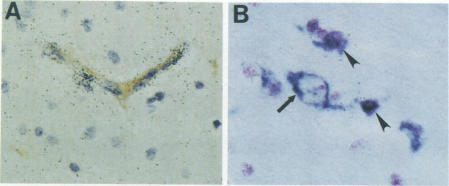
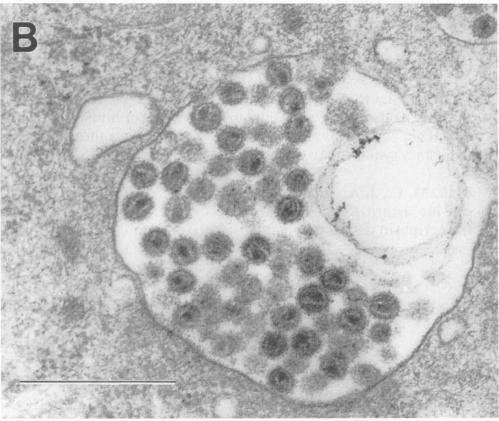
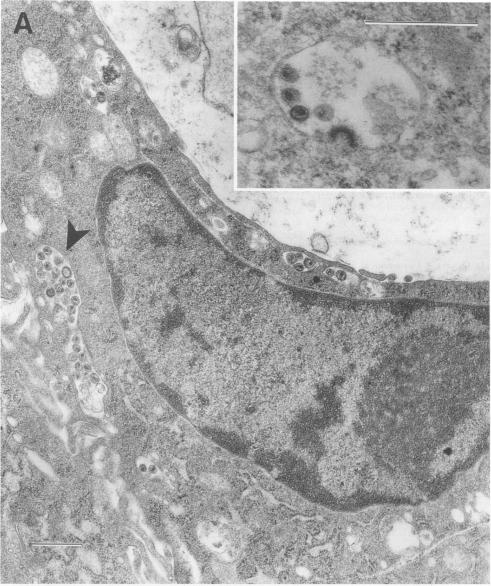
The perivascular location of human immunodeficiency virus-infected cells suggests that the virus enters the central nervous system (CNS) by traversing the blood-brain barrier (BBB). In this study, the simian immunodeficiency virus (SIV) macaque model was used to determine whether SIV infects CNS endothelial cells. SIV RNA was detected in capillary endothelial cells in brain sections from animals parenterally inoculated with a neurovirulent strain of SIV by double immunohistochemistry and in situ hybridization and by reverse transcriptase-in situ PCR. These in vivo observations were extended by examining whether SIV replicated productively in cultured macaque brain endothelial cells (MBEC). A neurovirulent strain, SIVmac239/17E-Br, replicated productively in MBEC as determined by the presence of viral cytopathic effect (syncytia), viral DNA by PCR, viral RNA by in situ hybridization, and viral antigen by immunohistochemistry and by the production of high titers of cell-free virus. Virus replication was confirmed by electron microscopy. In contrast, a nonneurovirulent strain, SIVmac239, did not infect MBEC. Infection of the endothelial cells was not blocked by soluble CD4. Thus, endothelial cells may provide a CD4-independent pathway of virus entry to the CNS. In addition, damage to the BBB as a result of endothelial cell infection may provide a mechanism for amplification of viral load in the CNS and may contribute to the CNS dysfunction that characterizes AIDS dementia and SIV encephalitis. These data suggest that MBEC may serve a selective role in determining virus entry to the CNS.
人类免疫缺陷病毒感染细胞的血管周围定位表明,该病毒通过穿越血脑屏障进入中枢神经系统(CNS)。在本研究中,使用猴免疫缺陷病毒(SIV)猕猴模型来确定SIV是否感染中枢神经系统内皮细胞。通过双重免疫组织化学、原位杂交以及逆转录酶原位PCR,在经肠道外接种神经毒性SIV株的动物脑切片的毛细血管内皮细胞中检测到了SIV RNA。通过检查SIV是否在培养的猕猴脑内皮细胞(MBEC)中高效复制,扩展了这些体内观察结果。一种神经毒性株SIVmac239/17E-Br在MBEC中高效复制,这通过病毒细胞病变效应(多核巨细胞)的存在、PCR检测病毒DNA、原位杂交检测病毒RNA、免疫组织化学检测病毒抗原以及产生高滴度的无细胞病毒来确定。通过电子显微镜证实了病毒复制。相比之下,一种非神经毒性株SIVmac239未感染MBEC。可溶性CD4未阻断内皮细胞的感染。因此,内皮细胞可能提供了一条不依赖CD4的病毒进入中枢神经系统的途径。此外,内皮细胞感染导致的血脑屏障损伤可能为中枢神经系统中病毒载量的扩增提供一种机制,并可能导致以艾滋病痴呆和SIV脑炎为特征的中枢神经系统功能障碍。这些数据表明,MBEC在决定病毒进入中枢神经系统方面可能起选择性作用。