Chou J, Poon A P, Johnson J, Roizman B
Marjorie B. Kovler Viral Oncology Laboratories, University of Chicago, Illinois 60637.
J Virol. 1994 Dec;68(12):8304-11. doi: 10.1128/JVI.68.12.8304-8311.1994.
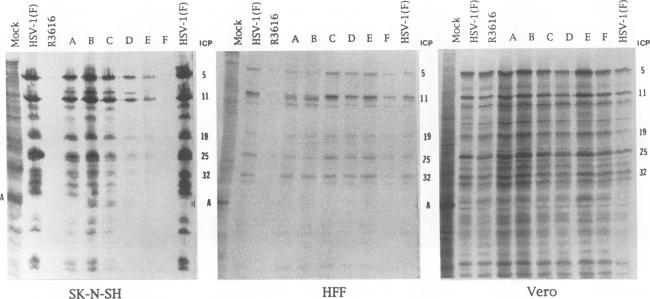
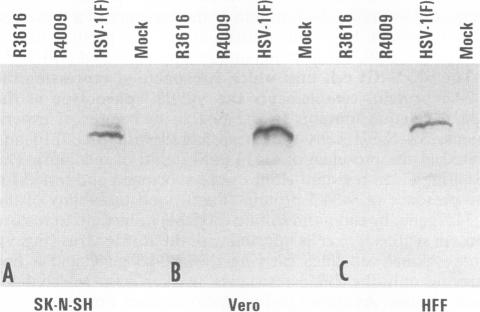
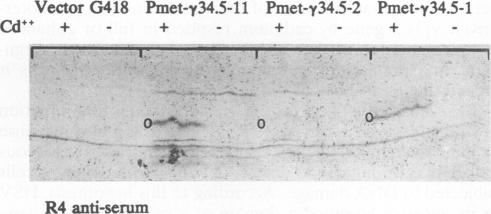
Earlier studies have shown that herpes simplex virus mutants lacking the gamma(1)34.5 gene are totally avirulent on intracerebral inoculation of the virus into mice and induce premature shutoff of protein synthesis in human neuroblastoma (SK-N-SH) cells but not in Vero cells. We report the following. (i) Whereas deletion mutant R3616, lacking 1,000 bp of the gamma(1)34.5 gene, caused premature shutoff of protein synthesis in both SK-N-SH and human foreskin fibroblasts (HFF), mutants R4009 and R930 (mutant F), carrying stop codons in all six frames, 27 and 210 codons from the initiation codon of the gamma(1)34.5 genes, respectively, induced shutoff of protein synthesis in SK-N-SH cells but not in HFF. The differences in behavior between the R3616 deletion and R4009 stop codon mutants cannot be attributed to differences in the rate of induction of premature shutoff of protein synthesis and the multiplicity of infection. HFF do not produce detectable truncated gamma(1)34.5 protein or truncated mRNA. (ii) Some clonal lines of SK-N-SH cells carrying a gamma(1)34.5 gene driven by a metallothionein promoter express the gamma(1)34.5 gene constitutively and do not require induction by cadmium to complement the gamma(1)34.5- virus. One clonal cell line complements the gamma(1)34.5- virus only after induction by cadmium. These results are consistent with previous conclusions that the phenotype of premature shutoff of protein synthesis is associated with absence of the gamma(1)34.5 protein and indicate that the amounts of gamma(1)34.5 protein necessary to complement the gamma(1)34.5- viruses are small. We conclude that human cells differ in the manner in which they respond to the presence of stop codons. Shutoff of protein synthesis in HFF infected with the stop codon mutants could have been precluded by small amounts of gamma(1)34.5 protein produced by splicing out of an intron containing the stop codon, downstream initiation of translation, or tRNA suppression of the stop codon.
早期研究表明,缺乏γ(1)34.5基因的单纯疱疹病毒突变体,将病毒脑内接种到小鼠体内时完全无毒,并且能在人神经母细胞瘤(SK-N-SH)细胞中诱导蛋白质合成过早关闭,但在Vero细胞中则不会。我们报告如下:(i)缺失γ(1)34.5基因1000 bp的缺失突变体R3616,在SK-N-SH细胞和人包皮成纤维细胞(HFF)中均能引起蛋白质合成过早关闭,而突变体R4009和R930(突变体F),在γ(1)34.5基因起始密码子分别下游27和210个密码子的所有六个阅读框中都带有终止密码子,它们能在SK-N-SH细胞中诱导蛋白质合成关闭,但在HFF中则不能。R3616缺失突变体和R4009终止密码子突变体行为上的差异,不能归因于蛋白质合成过早关闭的诱导速率和感染复数的差异。HFF不会产生可检测到的截短γ(1)34.5蛋白或截短mRNA。(ii)一些携带由金属硫蛋白启动子驱动的γ(1)34.5基因的SK-N-SH细胞克隆系,组成性表达γ(1)34.5基因,不需要镉诱导来补充γ(1)34.5 -病毒。一个克隆细胞系仅在镉诱导后才补充γ(1)34.5 -病毒。这些结果与先前的结论一致,即蛋白质合成过早关闭的表型与γ(1)34.5蛋白的缺失有关,并表明补充γ(1)34.5 -病毒所需的γ(1)34.5蛋白量很少。我们得出结论,人类细胞对终止密码子存在的反应方式不同。感染终止密码子突变体的HFF中蛋白质合成的关闭,可能已被通过切除包含终止密码子的内含子、翻译的下游起始或终止密码子的tRNA抑制产生的少量γ(1)34.5蛋白所阻止。