Hoff W D, Sprenger W W, Postma P W, Meyer T E, Veenhuis M, Leguijt T, Hellingwerf K J
Department of Microbiology, E. C. Slater Institute, University of Amsterdam, The Netherlands.
J Bacteriol. 1994 Jul;176(13):3920-7. doi: 10.1128/jb.176.13.3920-3927.1994.
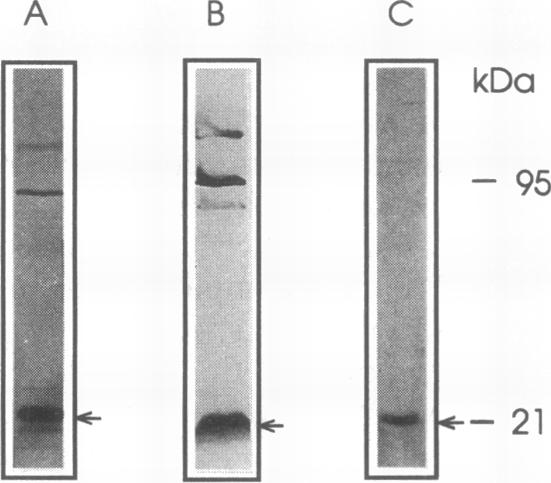
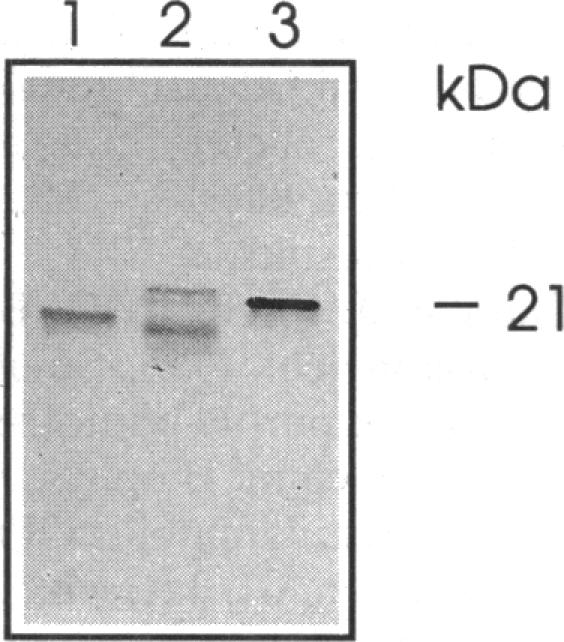
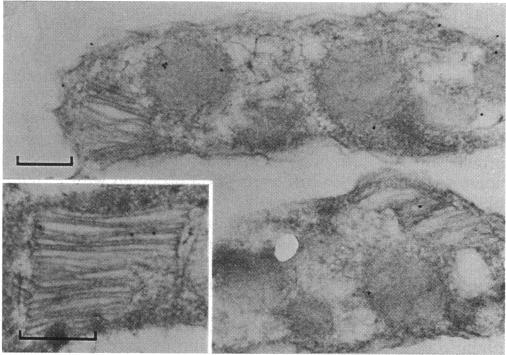
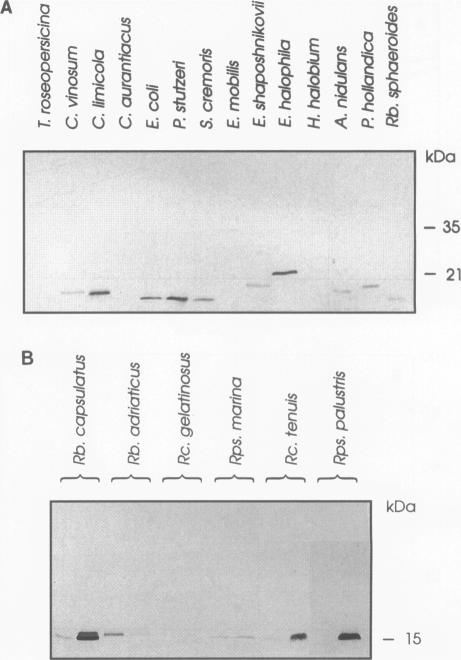
A rabbit antiserum was raised against the photoactive yellow protein (PYP) from Ectothiorhodospira halophila and purified by adsorption experiments to obtain a highly specific polyclonal antiserum. This antiserum was used to obtain the following results. (i) In E. halophila, PYP can be isolated from the fraction of soluble proteins. In the intact cell, however, PYP appeared to be associated with (intra)cytoplasmic membranes, as was concluded from analysis of immunogold-labelled thin sections of the organism. (ii) The regulation of expression of PYP was studied by using dot blot assays, Western blotting (immunoblotting), and rocket immunoelectrophoresis. Under all conditions investigated (light color, salt concentration, and growth phase), PYP was expressed constitutively in E. halophila. However, when Rhodospirillum salexigens was grown aerobically, the expression of PYP was suppressed. (iii) A large number of prokaryotic microorganisms contained a single protein, with an apparent size of approximately 15 kDa, that cross-reacted with the antiserum. Among the positively reacting organisms were both phototrophic and chemotrophic, as well as motile and nonmotile, organisms. After separation of cellular proteins into a membrane fraction and soluble proteins, it was established that organisms adapted to growth at higher salt concentrations tended to have the cross-reacting protein in the soluble fraction. In the cases of R. salexigens and Chromatium salexigens, we have shown that the cross-reacting protein involved is strongly homologous to PYP from E. halophila.