Bement W M, Hasson T, Wirth J A, Cheney R E, Mooseker M S
Department of Biology, Yale University, New Haven, CT 06520-8103.
Proc Natl Acad Sci U S A. 1994 Jul 5;91(14):6549-53. doi: 10.1073/pnas.91.14.6549.
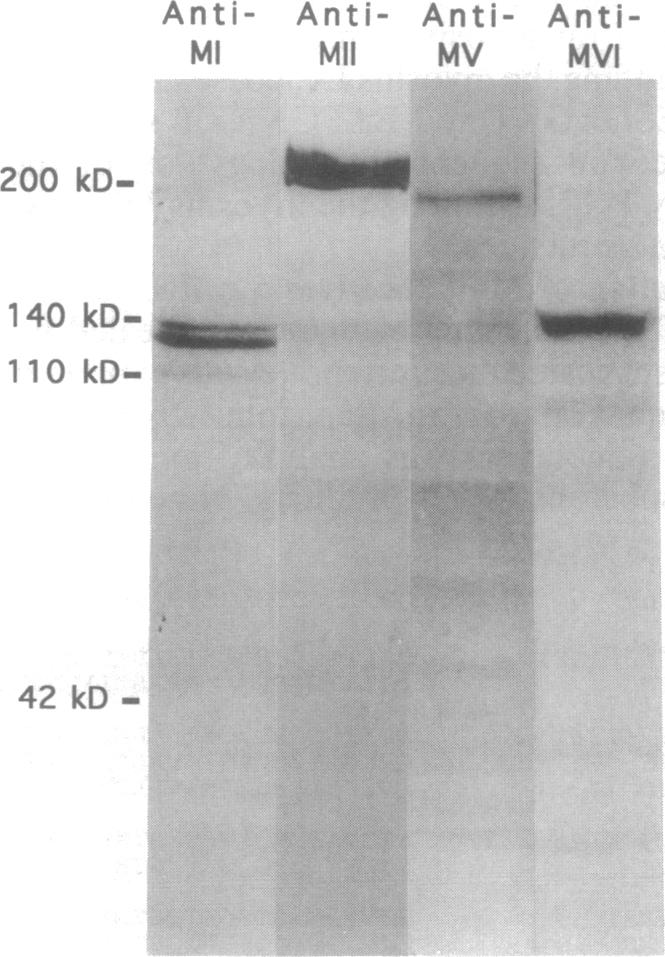
Myosin diversity in the human epithelial cell line Caco-2BBe, the porcine epithelial cell line LLC-PK1 (CL-4), human peripheral blood leukocytes, and human liver was analyzed. PCR amplification yielded 8-11 putative myosins (depending on the cDNA source) representing six distinct myosin classes. Analysis of clones obtained by hybridization screening demonstrated that the original PCR products correspond to bona fide myosins, based on the presence of sequences highly conserved in other myosins. RNase protection analysis confirmed mRNA expression of 11 myosins in Caco-2BBe cells. Immunoblot analysis showed that at least 6 myosin immunogens are expressed in Caco-2BBe cells. The results reveal the existence of at least 11 unconventional human myosin genes, most of which are expressed in an overlapping fashion in different cell types. The abundance of myosins suggests that the myosin I vs. myosin II paradigm is inadequate to explain actin-based cellular motility.
对人上皮细胞系Caco-2BBe、猪上皮细胞系LLC-PK1 (CL-4)、人外周血白细胞和人肝脏中的肌球蛋白多样性进行了分析。PCR扩增产生了8 - 11种推定的肌球蛋白(取决于cDNA来源),代表六种不同的肌球蛋白类别。对通过杂交筛选获得的克隆进行分析表明,基于在其他肌球蛋白中高度保守的序列的存在,原始PCR产物对应于真正的肌球蛋白。核糖核酸酶保护分析证实了Caco-2BBe细胞中11种肌球蛋白的mRNA表达。免疫印迹分析表明,Caco-2BBe细胞中至少表达6种肌球蛋白免疫原。结果揭示了至少11种非传统人类肌球蛋白基因的存在,其中大多数在不同细胞类型中以重叠方式表达。肌球蛋白的丰富性表明,肌球蛋白I与肌球蛋白II的模式不足以解释基于肌动蛋白的细胞运动。