Hayashi Y, Sunthornthepvarakul T, Refetoff S
Department of Medicine, University of Chicago, Illinois 60637.
J Clin Invest. 1994 Aug;94(2):607-15. doi: 10.1172/JCI117376.
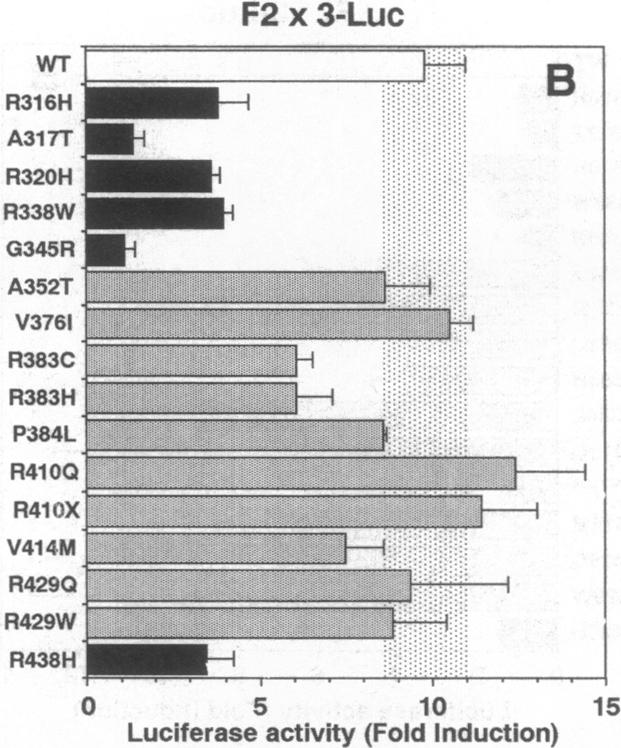
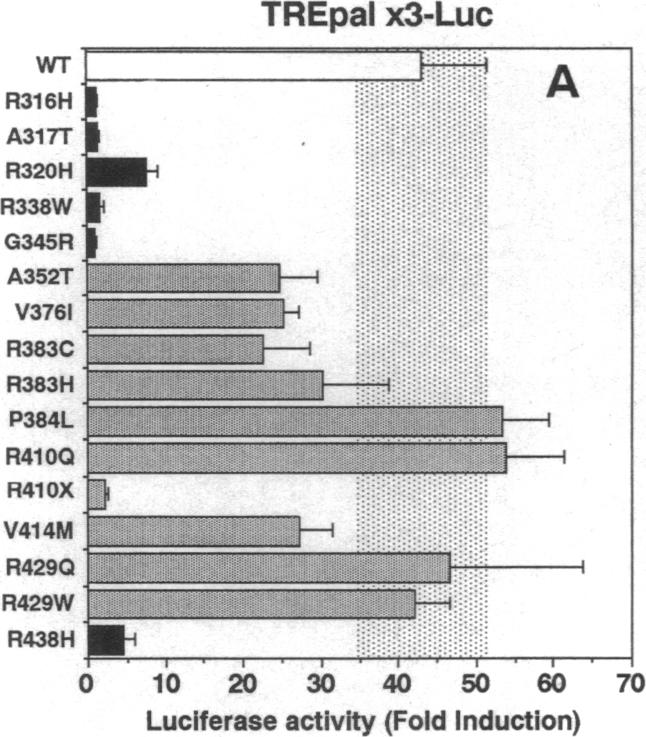
Thyroid hormone receptor (TR) beta gene mutations identified in patients with resistance to thyroid hormone (RTH) revealed two clusters ("hot" areas) of mutations (RTHmut) in the triiodothyronine (T3)-binding domain. Furthermore, 45% of RTHmuts and 90% of recurring mutations are located in CpG dinucleotides ("hot spots"). To investigate why the region between the two hot areas lacks RTHmuts, we produced 10 artificial mutant TR beta s (ARTmut) in this "cold" region according to the hot spot rule (C-->T or G-->A substitutions in CpGs). The properties of ARTmuts were compared with those of six RTHmuts. Among all RTHmuts, R320H manifesting a mild form of RTH showed the least impairment of T3-binding affinity (Ka). In contrast, Ka was normal in six ARTmuts (group A), reduced to a lesser extent than R320H in three (group B), and one that was truncated (R410X) did not bind T3. All RTHmuts had impaired ability to transactivate T3-responsive elements and exhibited a strong dominant negative effect on cotransfected wild-type TR beta. Group B and A ARTmuts had minimally impaired or normal transactivation and weak or no dominant negative effect, respectively. R410X showed neither transactivation nor dominant negative effect. Natural mutations expected to occur in the cold region of TR beta should fail to manifest as RTH (group A) or should escape detection (group B) since the serum thyroid hormone levels required to compensate for the reduced binding affinity should be inferior to those found in subjects with R320H. R410X would manifest RTH only in the homozygote state. The cold region of the putative T3-binding domain is relatively insensitive to amino acid changes and, thus, may not be involved in a direct interaction with T3.
在甲状腺激素抵抗(RTH)患者中鉴定出的甲状腺激素受体(TR)β基因突变揭示了三碘甲状腺原氨酸(T3)结合域中的两个突变簇(“热点”区域)(RTHmut)。此外,45%的RTHmut和90%的复发性突变位于CpG二核苷酸(“热点”)中。为了研究为什么两个热点区域之间的区域缺乏RTHmut,我们根据热点规则(CpG中的C→T或G→A替换)在这个“冷”区域产生了10个人工突变TRβ(ARTmut)。将ARTmut的特性与6个RTHmut的特性进行了比较。在所有RTHmut中,表现出轻度RTH形式的R320H对T3结合亲和力(Ka)的损害最小。相比之下,6个ARTmut(A组)的Ka正常,3个(B组)的Ka降低程度小于R320H,而一个截短的(R410X)不结合T3。所有RTHmut激活T3反应元件的能力受损,并对共转染的野生型TRβ表现出强烈的显性负效应。B组和A组ARTmut的转录激活受损最小或正常,显性负效应弱或无。R410X既无转录激活作用也无显性负效应。预计在TRβ冷区域发生的自然突变不应表现为RTH(A组)或应逃避检测(B组),因为补偿结合亲和力降低所需的血清甲状腺激素水平应低于R320H患者中的水平。R410X仅在纯合子状态下才会表现出RTH。假定的T3结合域的冷区域对氨基酸变化相对不敏感,因此可能不参与与T3的直接相互作用。