Knoll A H
Botanical Museum, Harvard University, Cambridge, MA 02138.
Proc Natl Acad Sci U S A. 1994 Jul 19;91(15):6743-50. doi: 10.1073/pnas.91.15.6743.
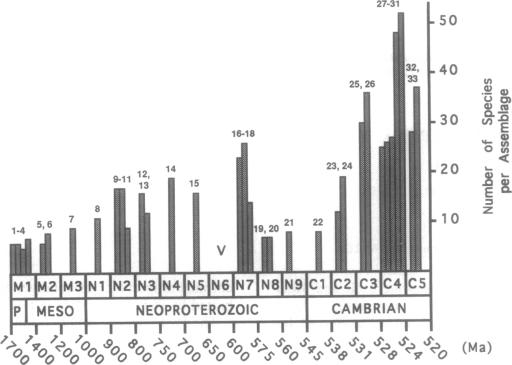
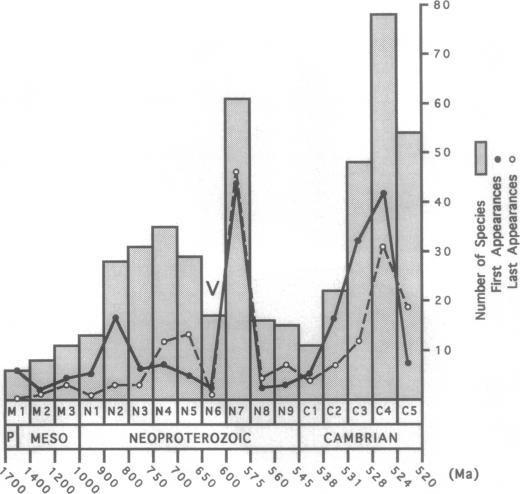
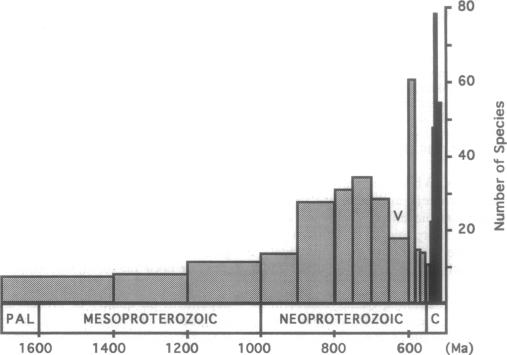
In rocks of late Paleoproterozoic and Mesoproterozoic age (ca. 1700-1000 million years ago), probable eukaryotic microfossils are widespread and well preserved, but assemblage and global diversities are low and turnover is slow. Near the Mesoproterozoic-Neoproterozoic boundary (1000 million years ago), red, green, and chromophytic algae diversified; molecular phylogenies suggest that this was part of a broader radiation of "higher" eukaryotic phyla. Observed diversity levels for protistan microfossils increased significantly at this time, as did turnover rates. Coincident with the Cambrian radiation of marine invertebrates, protistan microfossils again doubled in diversity and rates of turnover increased by an order of magnitude. Evidently, the Cambrian diversification of animals strongly influenced evolutionary rates, within clades already present in marine communities, implying an important role for ecology in fueling a Cambrian explosion that extends across kingdoms.
在古元古代晚期和中元古代(约17亿至10亿年前)的岩石中,可能的真核微化石广泛分布且保存完好,但组合和全球多样性较低,更替缓慢。接近中元古代 - 新元古代边界(10亿年前)时,红藻、绿藻和色素体藻类出现了多样化;分子系统发育表明,这是“高等”真核生物门类更广泛辐射的一部分。此时观察到的原生生物微化石多样性水平显著增加,更替率也是如此。与寒武纪海洋无脊椎动物的辐射同时发生的是,原生生物微化石的多样性再次翻倍,更替率增加了一个数量级。显然,动物的寒武纪多样化强烈影响了海洋群落中已存在的类群内的进化速率,这意味着生态在推动跨越多个界的寒武纪大爆发中发挥了重要作用。