Tsuchihashi Z, Brown P O
Howard Hughes Medical Institute, Standford, California.
J Virol. 1994 Sep;68(9):5863-70. doi: 10.1128/JVI.68.9.5863-5870.1994.
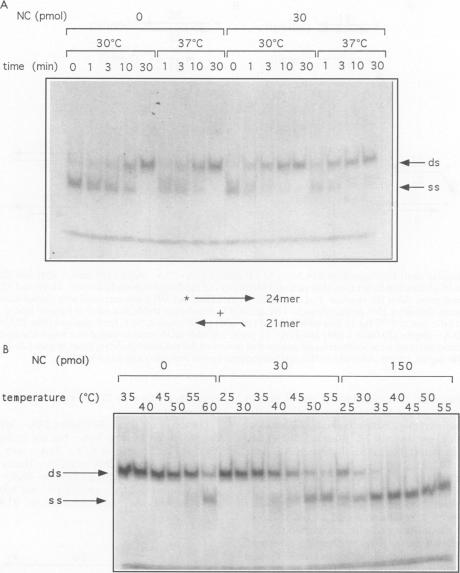
Nucleocapsid protein (NC) of human immunodeficiency virus type 1 (HIV-1) was expressed in Escherichia coli and purified. The protein displayed a variety of activities on DNA structure, all reflecting an ability to promote transition between double-helical and single-stranded conformations. We found that, in addition to its previously described ability to accelerate renaturation of complementary DNA strands, the HIV-1 NC protein could substantially lower the melting temperature of duplex DNA and could promote strand exchange between double-stranded and single-stranded DNA molecules. Moreover, in the presence of HIV-1 NC, annealing of a single-stranded DNA molecule to a complementary DNA strand that would yield a more stable double-stranded product was favored over annealing to alternative complementary DNA strands that would form less stable duplex products (selective annealing). NC thus appears to lower the kinetic barrier so that double-strand <==> single-strand equilibrium is rapidly reached to favor the lowest free-energy nucleic acid conformation. This activity of NC may be important for correct folding of viral genomic RNA and may have practical applications.
1型人类免疫缺陷病毒(HIV-1)的核衣壳蛋白(NC)在大肠杆菌中表达并纯化。该蛋白对DNA结构表现出多种活性,所有这些活性都反映了其促进双链和单链构象之间转变的能力。我们发现,除了其先前描述的加速互补DNA链复性的能力外,HIV-1 NC蛋白还能大幅降低双链DNA的解链温度,并能促进双链和单链DNA分子之间的链交换。此外,在HIV-1 NC存在的情况下,单链DNA分子与互补DNA链退火形成更稳定的双链产物,比与形成较不稳定双链产物的其他互补DNA链退火更受青睐(选择性退火)。因此,NC似乎降低了动力学障碍,从而迅速达到双链⇌单链平衡,以利于最低自由能的核酸构象。NC的这种活性可能对病毒基因组RNA的正确折叠很重要,并且可能具有实际应用价值。