Wallace D C
Department of Genetics and Molecular Medicine, Emory University School of Medicine, Atlanta, GA 30322.
Proc Natl Acad Sci U S A. 1994 Sep 13;91(19):8739-46. doi: 10.1073/pnas.91.19.8739.
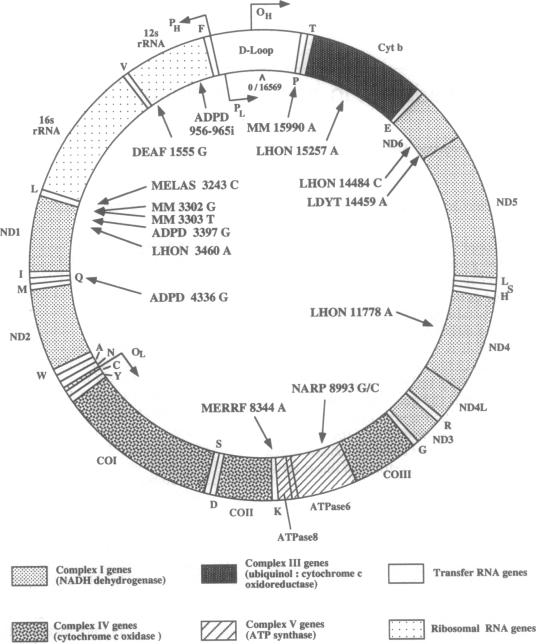
Germ-line and somatic mtDNA mutations are hypothesized to act together to shape our history and our health. Germ-line mtDNA mutations, both ancient and recent, have been associated with a variety of degenerative diseases. Mildly to moderately deleterious germ-line mutations, like neutral polymorphisms, have become established in the distant past through genetic drift but now may predispose certain individuals to late-onset degenerative diseases. As an example, a homoplasmic, Caucasian, tRNA(Gln) mutation at nucleotide pair (np) 4336 has been observed in 5% of Alzheimer disease and Parkinson disease patients and may contribute to the multifactorial etiology of these diseases. Moderately to severely deleterious germ-line mutations, on the other hand, appear repeatedly but are eliminated by selection. Hence, all extant mutations of this class are recent and associated with more devastating diseases of young adults and children. Representative of these mutations is a heteroplasmic mutation in MTND6 at np 14459 whose clinical presentations range from adult-onset blindness to pediatric dystonia and basal ganglial degeneration. To the inherited mutations are added somatic mtDNA mutations which accumulate in random arrays within stable tissues. These mutations provide a molecular clock that measures our age and may cause a progressive decline in tissue energy output that could precipitate the onset of degenerative diseases in individuals harboring inherited deleterious mutations.
生殖系和体细胞线粒体DNA突变被认为共同作用塑造了我们的历史和健康。生殖系线粒体DNA突变,无论古老的还是近期的,都与多种退行性疾病相关。轻度至中度有害的生殖系突变,如同中性多态性,在遥远的过去通过遗传漂变得以确立,但现在可能使某些个体易患迟发性退行性疾病。例如,在5%的阿尔茨海默病和帕金森病患者中观察到核苷酸对(np)4336处的纯合性、白种人的tRNA(Gln)突变,它可能促成这些疾病的多因素病因。另一方面,中度至重度有害的生殖系突变反复出现,但通过选择被消除。因此,这类现存的所有突变都是近期的,且与年轻人和儿童更具毁灭性的疾病相关。这类突变的代表是MTND6中np 14459处的异质性突变,其临床表现从成人期失明到儿童肌张力障碍和基底神经节变性不等。除了遗传突变外,还有体细胞线粒体DNA突变,它们在稳定组织内以随机阵列形式积累。这些突变提供了一个衡量我们年龄的分子时钟,并可能导致组织能量输出逐渐下降,这可能促使携带遗传性有害突变的个体发生退行性疾病。