Denis D, Bullock P A
Department of Biochemistry, Tufts University School of Medicine, Boston, Massachusetts 02111.
Mol Cell Biol. 1993 May;13(5):2882-90. doi: 10.1128/mcb.13.5.2882-2890.1993.
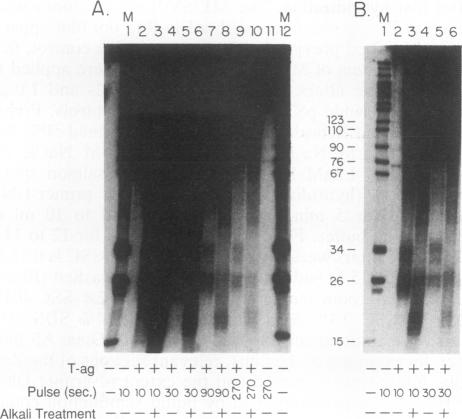
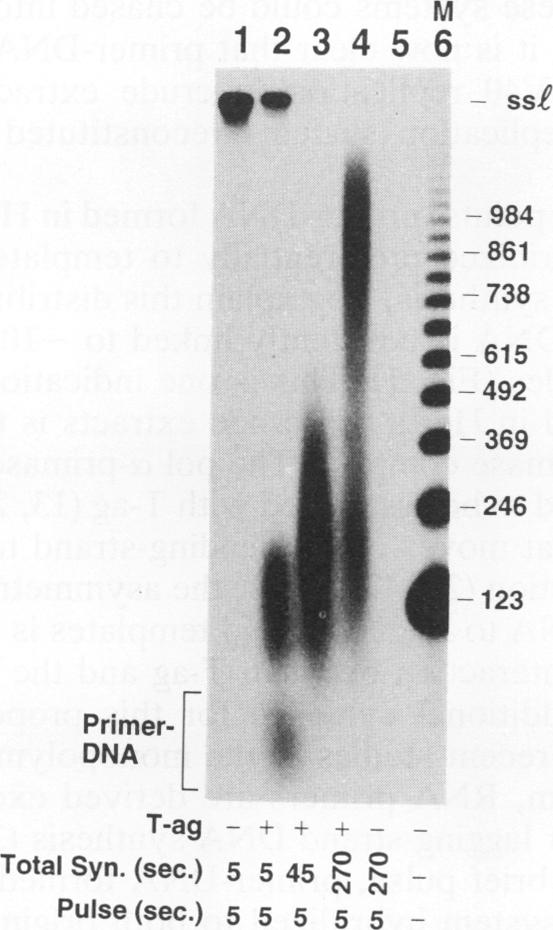
Studies of simian virus 40 (SV40) DNA replication in vitro have identified a small (approximately 30-nucleotide) RNA-DNA hybrid species termed primer-DNA. Initial experiments indicated that T antigen and the polymerase alpha-primase complex are required to form primer-DNA. Proliferating cell nuclear antigen, and presumably proliferating cell nuclear antigen-dependent polymerases, is not needed to form this species. Herein, we present an investigation of the stages at which primer-DNA functions during SV40 DNA replication in vitro. Hybridization studies indicate that primer-DNA is initially formed in the origin region and is subsequently synthesized in regions distal to the origin. At all time points, primer-DNA is synthesized from templates for lagging-strand DNA replication. These studies indicate that primer-DNA functions during both initiation and elongation stages of SV40 DNA synthesis. Results of additional experiments suggesting a precursor-product relationship between formation of primer-DNA and Okazaki fragments are presented.
对猿猴病毒40(SV40)体外DNA复制的研究鉴定出一种小的(约30个核苷酸)RNA-DNA杂交分子,称为引物-DNA。最初的实验表明,T抗原和聚合酶α-引发酶复合物是形成引物-DNA所必需的。增殖细胞核抗原以及推测的依赖增殖细胞核抗原的聚合酶在形成该分子时并非必需。在此,我们对引物-DNA在SV40体外DNA复制过程中发挥作用的阶段进行了研究。杂交研究表明,引物-DNA最初在起始区域形成,随后在起始点远端的区域合成。在所有时间点,引物-DNA都是从滞后链DNA复制的模板合成的。这些研究表明,引物-DNA在SV40 DNA合成的起始和延伸阶段均发挥作用。还展示了其他实验结果,这些结果表明引物-DNA的形成与冈崎片段之间存在前体-产物关系。