Matar G M, Swaminathan B, Hunter S B, Slater L N, Welch D F
Meningitis and Special Pathogens Branch, Centers for Disease Control, Atlanta, Georgia 30333.
J Clin Microbiol. 1993 Jul;31(7):1730-4. doi: 10.1128/jcm.31.7.1730-1734.1993.
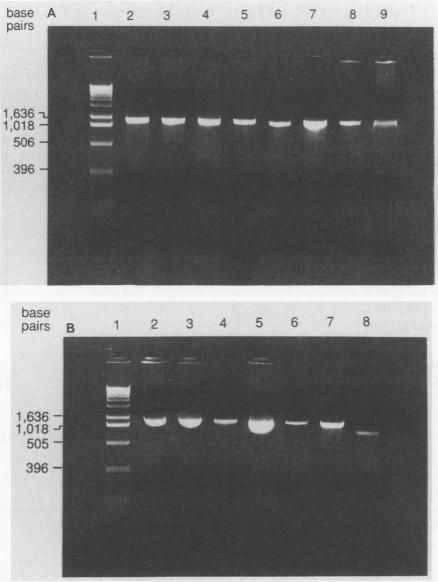
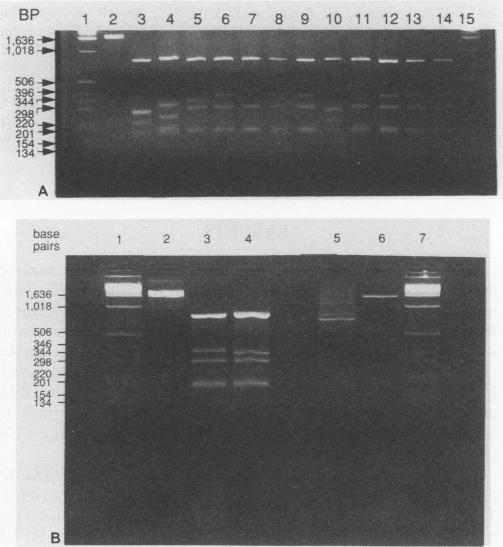
Restriction endonuclease analysis of a polymerase chain reaction-amplified DNA fragment which included the spacer region between the genes coding for 16S and 23S rRNAs and a portion of the gene coding for 23S rRNA (spacer + 23S) was done on 10 previously characterized clinical isolates of Rochalimaea henselae, one clinical isolate of Rochalimaea quintana, and the type strains of R. henselae, R. quintana, Rochalimaea vinsonii, and Bartonella bacilliformis. Brucella abortus DNA was not amplified by the primer set used. The clinical isolates of Rochalimaea were obtained from blood or tissue from patients with and without preexisting disease. The amplicon from each strain was digested with five endonucleases (AluI, HaeIII, TaqI, HinfI, and MseI). AluI and HaeIII were useful in species differentiation and subtyping of R. henselae. R. henselae isolates showed six different restriction patterns with AluI and four patterns with HaeIII. TaqI, HinfI, and MseI were useful only in species differentiation. These observations indicate that PCR amplification of the spacer + 23S region of the ribosomal DNA of Rochalimaea spp., along with restriction endonuclease analysis, allows differentiation of Rochalimaea spp. from closely related genera, differentiation among the species within Rochalimaea, and differentiation of strains within R. henselae. The subtyping potential of this method may be useful for further clinical and epidemiologic studies of the spectrum of diseases caused by R. henselae.
对10株先前已鉴定的汉赛罗卡利马氏体临床分离株、1株五日热罗卡利马氏体临床分离株以及汉赛罗卡利马氏体、五日热罗卡利马氏体、文森氏罗卡利马氏体和杆菌状巴尔通体的模式菌株,进行了聚合酶链反应扩增的DNA片段的限制性内切酶分析,该片段包括编码16S和23S rRNA的基因之间的间隔区以及编码23S rRNA的基因的一部分(间隔区 + 23S)。所用引物组未扩增出流产布鲁氏菌DNA。罗卡利马氏体的临床分离株取自患有和未患有既往疾病患者的血液或组织。用五种内切酶(AluI、HaeIII、TaqI、HinfI和MseI)消化各菌株的扩增子。AluI和HaeIII可用于汉赛罗卡利马氏体的种属鉴别和亚型分析。汉赛罗卡利马氏体分离株用AluI显示出六种不同的限制性模式,用HaeIII显示出四种模式。TaqI、HinfI和MseI仅用于种属鉴别。这些观察结果表明,罗卡利马氏体属核糖体DNA间隔区 + 23S区域的PCR扩增,结合限制性内切酶分析,能够将罗卡利马氏体属与密切相关属区分开来,区分罗卡利马氏体内的种,并区分汉赛罗卡利马氏体内的菌株。该方法的亚型分析潜力可能有助于对由汉赛罗卡利马氏体引起的疾病谱进行进一步的临床和流行病学研究。