White S A, Bond C T, Francis R C, Kasten T L, Fernald R D, Adelman J P
Program in Neuroscience, Stanford University, CA 94305-2130.
Proc Natl Acad Sci U S A. 1994 Feb 15;91(4):1423-7. doi: 10.1073/pnas.91.4.1423.
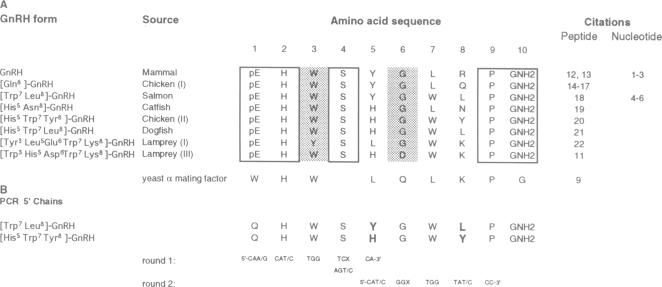
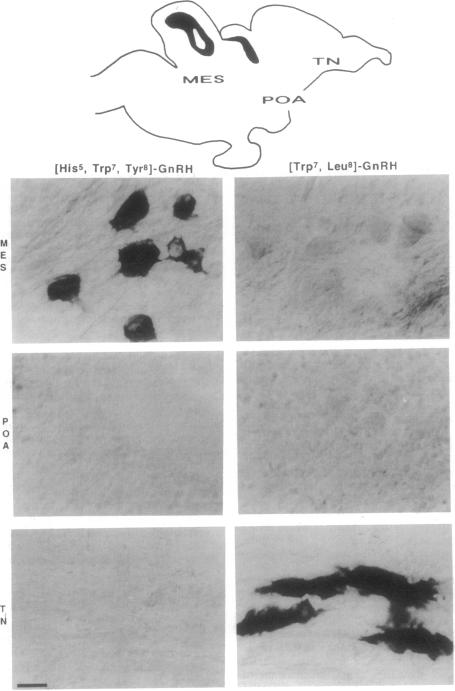
In vertebrates, the gonadotropin-releasing hormone (GnRH) decapeptide is secreted from hypothalamic nerve terminals to regulate reproduction via control of synthesis and release of pituitary gonadotropins. Only one GnRH peptide has been found in mammals, with one exception, although numerous other vertebrate species express more than one of the eight known decapeptide forms as shown by immunocytochemical labeling of distinct cell groups in the brain. However, neither the functional nor the evolutionary relationships among these GnRH forms are clear, because only one preprohormone gene sequence from any species has been reported. The most ubiquitous alternative form of GnRH is [His5,Trp7,Tyr8]GnRH (also referred to as chicken-II), which differs from the mammalian sequence at amino acids 5, 7, and 8. This peptide has been shown to have the most potent releasing-hormone activity, although immunocytochemical staining has suggested it is synthesized only in the mesencephalon. Here we report the cloning and expression pattern of the gene for the precursor of this form from the teleost fish Haplochromis burtoni. This is the second GnRH-encoding gene to be characterized in this species. The newly discovered preprohormone gene differs from that previously reported in two ways. First, whereas the original gene predicts only a single associated peptide, this one predicts two associated peptides, both of which appear to be unique. Second, the gene for [His5,Trp7,Tyr8]GnRH is expressed in only one cell group in the mesencephalon. In contrast, the previously reported gene is expressed only in the terminal nerve. The striking differences between the preprohormone structure and localization suggest that the genes coding for the two known GnRH forms in H. burtoni did not arise from a recent duplication event. Interestingly, neither of the two genes found to date in this species is expressed in cells which project from the hypothalamus to the pituitary, suggesting that yet a third gene coding for GnRH may exist.
在脊椎动物中,促性腺激素释放激素(GnRH)十肽由下丘脑神经末梢分泌,通过控制垂体促性腺激素的合成与释放来调节生殖。在哺乳动物中,除了一个例外,只发现了一种GnRH肽,尽管许多其他脊椎动物物种表达了八种已知十肽形式中的一种以上,这通过对大脑中不同细胞群的免疫细胞化学标记得以显示。然而,这些GnRH形式之间的功能关系和进化关系都不清楚,因为任何物种仅报道了一个前激素原基因序列。GnRH最普遍的替代形式是[His5,Trp7,Tyr8]GnRH(也称为鸡-II),它在氨基酸5、7和8处与哺乳动物序列不同。尽管免疫细胞化学染色表明它仅在中脑合成,但该肽已被证明具有最强的释放激素活性。在此,我们报道了来自硬骨鱼伯氏朴丽鱼(Haplochromis burtoni)的这种形式前体基因的克隆及表达模式。这是该物种中第二个被鉴定的GnRH编码基因。新发现的前激素原基因与先前报道的基因在两个方面有所不同。首先,原来的基因仅预测一种相关肽,而这个基因预测有两种相关肽,且这两种肽似乎都是独特的。其次,[His5,Trp7,Tyr8]GnRH基因仅在中脑的一个细胞群中表达。相比之下,先前报道的基因仅在终末神经中表达。前激素原结构和定位之间的显著差异表明,伯氏朴丽鱼中编码两种已知GnRH形式的基因并非来自近期的复制事件。有趣的是,该物种迄今为止发现的两个基因均未在下丘脑向垂体投射的细胞中表达,这表明可能存在编码GnRH的第三个基因。