Pietenpol J A, Tokino T, Thiagalingam S, el-Deiry W S, Kinzler K W, Vogelstein B
Oncology Center, Johns Hopkins University School of Medicine, Baltimore, MD 21231.
Proc Natl Acad Sci U S A. 1994 Mar 15;91(6):1998-2002. doi: 10.1073/pnas.91.6.1998.
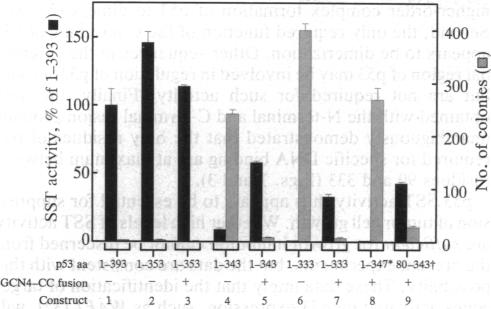
Although several biochemical features of p53 have been described, their relationship to tumor suppression remains uncertain. We have compared the ability of p53-derived proteins to act as sequence-specific transcriptional (SST) activators with their ability to suppress tumor cell growth, using an improved growth-suppression assay. Both naturally occurring and in vitro derived mutations that abrogated the SST activity of p53 lost the ability to suppress tumor cell growth. Additionally, the N- and C-terminal ends of p53 were shown to be functionally replaceable with foreign transactivation and dimerization domains, respectively, with concordant preservation of both SST and tumor-suppressive properties. Only the central region of p53, conferring specific DNA binding, was required to suppress growth by such hybrid proteins. The SST activity of p53 thus appeared to be essential for the protein to function as a tumor suppressor.
尽管已经描述了p53的几种生化特征,但其与肿瘤抑制的关系仍不确定。我们使用改进的生长抑制试验,比较了p53衍生蛋白作为序列特异性转录(SST)激活剂的能力与其抑制肿瘤细胞生长的能力。消除p53的SST活性的天然存在和体外衍生的突变均丧失了抑制肿瘤细胞生长的能力。此外,p53的N端和C端分别显示可被外源反式激活和二聚化结构域功能替代,同时保留SST和肿瘤抑制特性。此类杂交蛋白仅需要p53赋予特异性DNA结合的中央区域来抑制生长。因此,p53的SST活性似乎对于该蛋白发挥肿瘤抑制作用至关重要。