Kafri T, Gao X, Razin A
Department of Cellular Biochemistry, Hebrew University-Hadassah Medical School, Jerusalem, Israel.
Proc Natl Acad Sci U S A. 1993 Nov 15;90(22):10558-62. doi: 10.1073/pnas.90.22.10558.
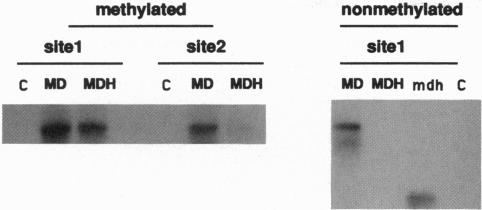
Gene-specific methylation patterns in mammals play a role in a variety of biological processes in the embryo and adult tissues. These patterns are established during embryo development by a process that involves genome-wide demethylation in the morula and de novo methylation in the pregastrula. To elucidate the mechanism of demethylation in the early mouse embryo, we have injected mouse zygotes with gene sequences that were methylated in vitro by Hpa II methylase and analyzed the methylation status of specific sites in blastocyst DNA. Because it had been propagated in Escherichia coli, the DNA used for these injections was also methylated at adenine residues in GATC sites. This allowed us to eliminate fully methylated, unintegrated DNA by Dpn I digestion and fully unmethylated, integrated DNA that underwent several rounds of replication by Mbo I digestion. The integrated, originally injected DNA strands were in a hemimethylated state and survived this treatment. The methylation status of Hpa II sites in these molecules was analyzed by Hpa II digestion of the genomic DNA isolated from blastocysts, followed by PCR amplification using appropriate primers. The results demonstrate that demethylation is achieved by an active mechanism and that specific sites in imprinted genes escape demethylation, maintaining a methylated state throughout preimplantation development.
哺乳动物中基因特异性甲基化模式在胚胎和成年组织的多种生物学过程中发挥作用。这些模式在胚胎发育过程中通过一个涉及桑椹胚全基因组去甲基化和原肠胚前期从头甲基化的过程得以确立。为阐明小鼠早期胚胎中去甲基化的机制,我们向小鼠受精卵注射了经Hpa II甲基化酶体外甲基化的基因序列,并分析了囊胚DNA中特定位点的甲基化状态。由于用于这些注射的DNA是在大肠杆菌中繁殖的,其在GATC位点的腺嘌呤残基处也被甲基化。这使我们能够通过Dpn I消化消除完全甲基化的未整合DNA,并通过Mbo I消化消除经过几轮复制的完全未甲基化的整合DNA。整合的、最初注射的DNA链处于半甲基化状态,并在这种处理中存活下来。通过对从囊胚中分离的基因组DNA进行Hpa II消化,然后使用适当引物进行PCR扩增,分析了这些分子中Hpa II位点的甲基化状态。结果表明,去甲基化是通过一种主动机制实现的,并且印记基因中的特定位点逃避去甲基化,在整个植入前发育过程中保持甲基化状态。