Lee Y H, Yano M, Liu S Y, Matsunaga E, Johnson P F, Gonzalez F J
Laboratory of Molecular Carcinogenesis, National Cancer Institute, National Institutes of Health, Bethesda, Maryland 20892.
Mol Cell Biol. 1994 Feb;14(2):1383-94. doi: 10.1128/mcb.14.2.1383-1394.1994.
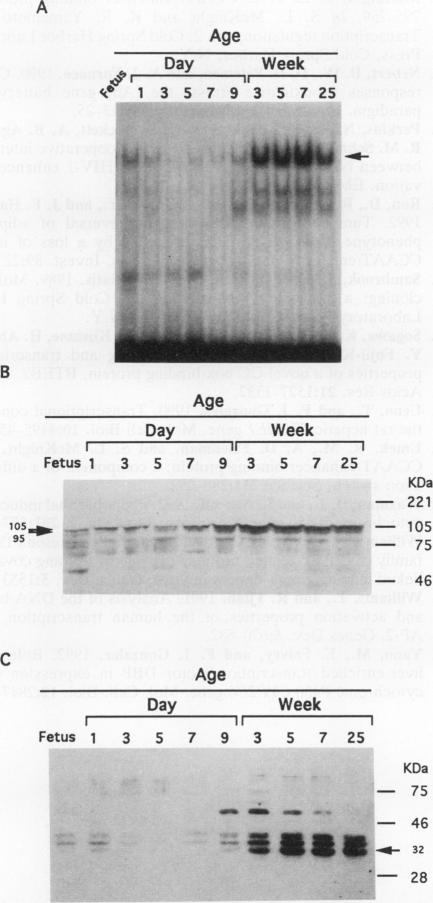
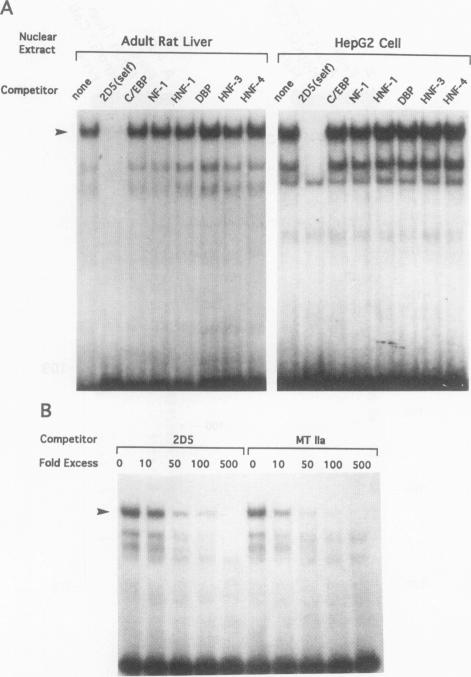
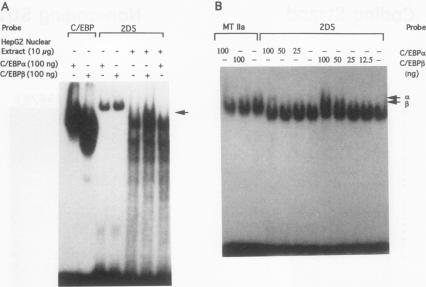
The rat CYP2D5 gene encodes a cytochrome P450 and is expressed in liver cells. Its expression commences a few days after birth, and maximal mRNA levels are achieved when animals reach puberty. Transfection and DNA binding studies were performed to investigate the mechanism controlling developmentally programmed, liver-specific expression of CYP2D5. Transfection studies using a series of CYP2D5 upstream DNA chloramphenicol acetyltransferase gene fusion constructs identified a segment of DNA between nucleotides -55 and -156 that conferred transcriptional activity in HepG2 cells. Activity was markedly increased by cotransfection with a vector expressing C/EBP beta but was unaffected by vectors producing other liver-enriched transcription factors (C/EBP alpha, HNF-1 alpha, and DBP). DNase I footprinting revealed a region protected by both HepG2 and liver cell nuclear extracts between nucleotides -83 and -112. This region displayed some sequence similarity to the Sp1 consensus sequence and was able to bind the Sp1 protein, as assessed by a gel mobility shift assay. The role of Sp1 in CYP2D5 transcription was confirmed by trans activation of the 2D5-CAT construct in Drosophila melanogaster cells by using an Sp1 expression vector. C/EBP beta alone was unable to directly bind the -83 to -112 region of the promoter but was able to produce a ternary complex when combined with HepG2 nuclear extracts or recombinant human Sp1. C/EBP alpha was unable to substitute for C/EBP beta in forming this ternary complex. A poor C/EBP binding site is present adjacent to the Sp1 site, and mutagenesis of this site abolished formation of the ternary complex with the CYP2D5 regulatory region. These result establish that two transcription factors can work in conjunction, possibly by protein-protein interaction, to activate the CYP2D5 gene.
大鼠CYP2D5基因编码一种细胞色素P450,在肝细胞中表达。其表达在出生后几天开始,动物进入青春期时达到最大mRNA水平。进行转染和DNA结合研究以探究控制CYP2D5发育程序化、肝脏特异性表达的机制。使用一系列CYP2D5上游DNA氯霉素乙酰转移酶基因融合构建体进行的转染研究确定了核苷酸-55至-156之间的一段DNA,该段DNA赋予了HepG2细胞中的转录活性。与表达C/EBPβ的载体共转染可显著增加活性,但不受产生其他肝脏富集转录因子(C/EBPα、HNF-1α和DBP)的载体影响。DNase I足迹分析显示,HepG2和肝细胞核提取物在核苷酸-83至-112之间保护了一个区域。通过凝胶迁移率变动分析评估,该区域与Sp1共有序列显示出一些序列相似性,并且能够结合Sp1蛋白。通过使用Sp1表达载体在果蝇细胞中转激活2D5-CAT构建体,证实了Sp1在CYP2D5转录中的作用。单独的C/EBPβ无法直接结合启动子的-83至-112区域,但与HepG2核提取物或重组人Sp1结合时能够产生三元复合物。C/EBPα在形成这种三元复合物时无法替代C/EBPβ。在Sp1位点附近存在一个较差的C/EBP结合位点,对该位点进行诱变消除了与CYP2D5调控区域形成三元复合物的能力。这些结果表明,两种转录因子可能通过蛋白质-蛋白质相互作用协同作用,以激活CYP2D5基因。