Leyer G J, Johnson E A
Department of Food Microbiology and Toxicology, University of Wisconsin, Madison 53706.
Appl Environ Microbiol. 1993 Jun;59(6):1842-7. doi: 10.1128/aem.59.6.1842-1847.1993.
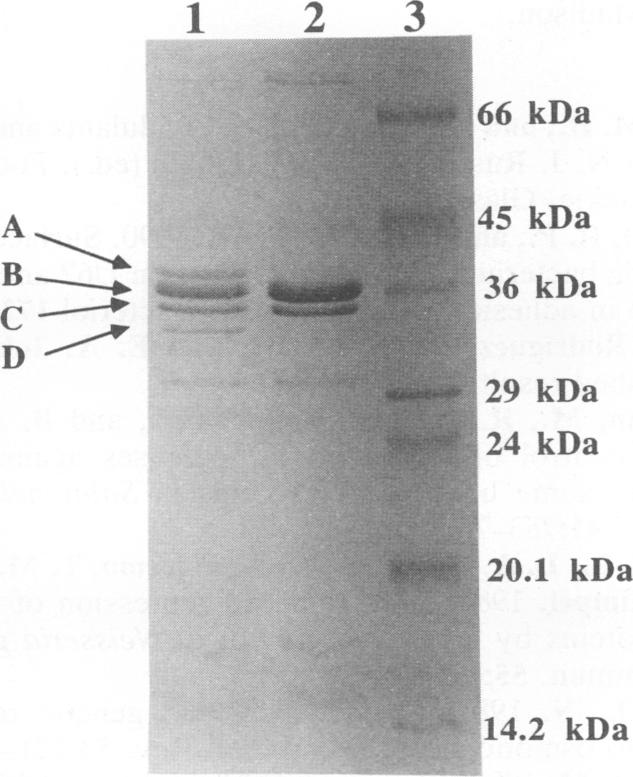
The relationship of acid adaptation to tolerance of other environmental stresses was examined in Salmonella typhimurium. S. typhimurium was adapted to acid by exposing the cells to mildly acidic conditions (pH 5.8) for one to two cell doublings. Acid-adapted cells were found to have increased tolerance towards various stresses including heat, salt, an activated lactoperoxidase system, and the surface-active agents crystal violet and polymyxin B. Acid adaptation increased cell surface hydrophobicity. Specific outer membrane proteins were induced by acid adaptation, but the lipopolysaccharide component appeared to be unaltered. These results show that acid adaptation alters cellular resistance to a variety of environmental stresses. The mechanism of acid-induced cross-protection involved changes in cell surface properties in addition to the known enhancement of intracellular pH homeostasis.
在鼠伤寒沙门氏菌中研究了酸适应性与对其他环境压力耐受性之间的关系。通过将细胞暴露于轻度酸性条件(pH 5.8)下进行一到两次细胞倍增,使鼠伤寒沙门氏菌适应酸性环境。发现酸适应细胞对包括热、盐、活化的乳过氧化物酶系统以及表面活性剂结晶紫和多粘菌素B在内的各种压力具有更高的耐受性。酸适应增加了细胞表面疏水性。酸适应诱导了特定的外膜蛋白,但脂多糖成分似乎未发生改变。这些结果表明,酸适应改变了细胞对多种环境压力的抗性。除了已知的细胞内pH稳态增强外,酸诱导的交叉保护机制还涉及细胞表面特性的变化。