Hou Y M, Westhof E, Giegé R
Unité de Recherche Propre Structures des Macromolécules Biologiques et Mecanismes de Reconnaissance, Centre National de la Recherche Scientifique, Strasbourg, France.
Proc Natl Acad Sci U S A. 1993 Jul 15;90(14):6776-80. doi: 10.1073/pnas.90.14.6776.
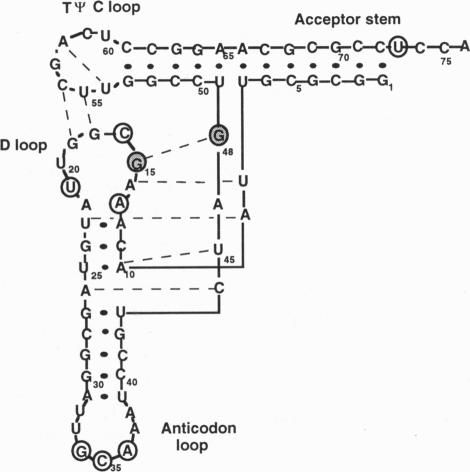
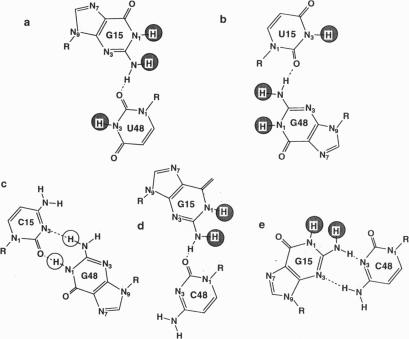
The nucleotides in a tRNA that specifically interact with the cognate aminoacyl-tRNA synthetase have been found largely located in the helical stems, the anticodon, or the discriminator base, where they vary from one tRNA to another. The conserved and semiconserved nucleotides that are responsible for the tRNA tertiary structure have been shown to have little role in synthetase recognition. Here we report that aminoacylation of Escherichia coli tRNA(Cys) depends on the anticodon, the discriminator base, and a tertiary interaction between the semiconserved nucleotides at positions 15 and 48. While all other tRNAs contain a purine at position 15 and a complementary pyrimidine at position 48 that establish the tertiary interaction known as the Levitt pair, E. coli tRNA(Cys) has guanosine -15 and -48. Replacement of guanosine -15 or -48 with cytidine virtually eliminates aminoacylation. Structural analyses with chemical probes suggest that guanosine -15 and -48 interact through hydrogen bonds between the exocyclic N-2 and ring N-3 to stabilize the joining of the two long helical stems of the tRNA. This tertiary interaction is different from the traditional base pairing scheme in the Levitt pair, where hydrogen bonds would form between N-1 and O-6. Our results provide evidence for a role of RNA tertiary structure in synthetase recognition.
已发现,与同源氨酰 - tRNA合成酶特异性相互作用的tRNA中的核苷酸,大多位于螺旋茎、反密码子或鉴别碱基中,这些核苷酸在不同的tRNA之间存在差异。负责tRNA三级结构的保守和半保守核苷酸,在合成酶识别中作用甚微。在此我们报告,大肠杆菌tRNA(Cys)的氨酰化作用取决于反密码子、鉴别碱基,以及第15位和第48位半保守核苷酸之间的三级相互作用。所有其他tRNA在第15位含有一个嘌呤,在第48位含有一个互补嘧啶,二者形成被称为莱维特配对的三级相互作用,而大肠杆菌tRNA(Cys)在第15位和第48位是鸟苷。用胞苷取代鸟苷 -15或 -48实际上会消除氨酰化作用。化学探针的结构分析表明,鸟苷 -15和 -48通过环外N - 2和环N - 3之间的氢键相互作用,以稳定tRNA两条长螺旋茎的连接。这种三级相互作用不同于莱维特配对中的传统碱基配对模式,在后者中,氢键会在N - 1和O - 6之间形成。我们的结果为RNA三级结构在合成酶识别中的作用提供了证据。