Alksne L E, Anthony R A, Liebman S W, Warner J R
Department of Cell Biology, Albert Einstein College of Medicine, Bronx, NY 10461.
Proc Natl Acad Sci U S A. 1993 Oct 15;90(20):9538-41. doi: 10.1073/pnas.90.20.9538.
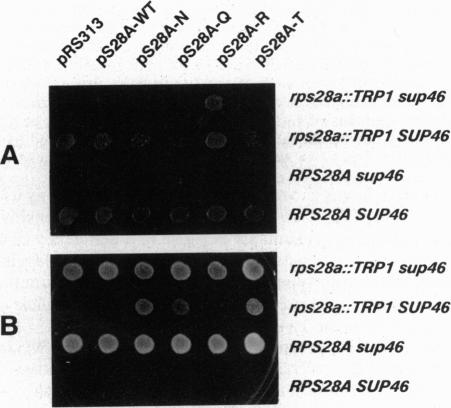
The accuracy of translation in Escherichia coli is profoundly influenced by three interacting ribosomal proteins, S12, S4, and S5. Mutations at lysine-42 of S12, originally isolated as causing resistance to streptomycin, increase accuracy. Countervailing "ribosomal ambiguity mutations" (ram) in S4 or S5 decrease accuracy. In the eukaryotic ribosome of Saccharomyces cerevisiae, mutations in SUP46 and SUP44, encoding the proteins equivalent to S4 and S5, lead to omnipotent suppression--i.e., to less accurate translation. The evolution of ribosomal protein S12 can be traced, by comparison with archaebacteria and Tetrahymena, to S28 of S. cerevisiae, even though the two proteins share only very limited regions of homology. However, one region that has been conserved contains a lysine residue whose mutation leads to increased accuracy in E. coli. We have introduced into S28 of yeast the same amino acid substitutions that led to the original streptomycin-resistant mutations in E. coli. We find that they have a profound effect on the accuracy of translation and interact with SUP44 and SUP46, just as predicted from the E. coli model. Thus, the interplay of these three proteins to provide the optimal level of accuracy of translation has been conserved during the 2 billion years of evolution that separate E. coli from S. cerevisiae.
大肠杆菌中的翻译准确性受到三种相互作用的核糖体蛋白S12、S4和S5的深刻影响。最初作为对链霉素产生抗性而分离出来的S12赖氨酸-42位点的突变会提高翻译准确性。S4或S5中的“核糖体模糊性突变”(ram)则会降低翻译准确性。在酿酒酵母的真核核糖体中,编码与S4和S5等效蛋白质的SUP46和SUP44中的突变会导致全能抑制,即翻译准确性降低。通过与古细菌和四膜虫进行比较,核糖体蛋白S12的进化可以追溯到酿酒酵母的S28,尽管这两种蛋白质仅共享非常有限的同源区域。然而,一个保守的区域包含一个赖氨酸残基,其突变会导致大肠杆菌中的翻译准确性提高。我们已将导致大肠杆菌中最初链霉素抗性突变的相同氨基酸替代引入酵母的S28中。我们发现它们对翻译准确性有深远影响,并与SUP44和SUP46相互作用,正如从大肠杆菌模型中预测的那样。因此,在将大肠杆菌与酿酒酵母分开的20亿年进化过程中,这三种蛋白质相互作用以提供最佳翻译准确性水平的机制一直得以保留。