Janszen F H, Cooke B A, van der Molen H J
Biochem J. 1977 Feb 15;162(2):341-6. doi: 10.1042/bj1620341.
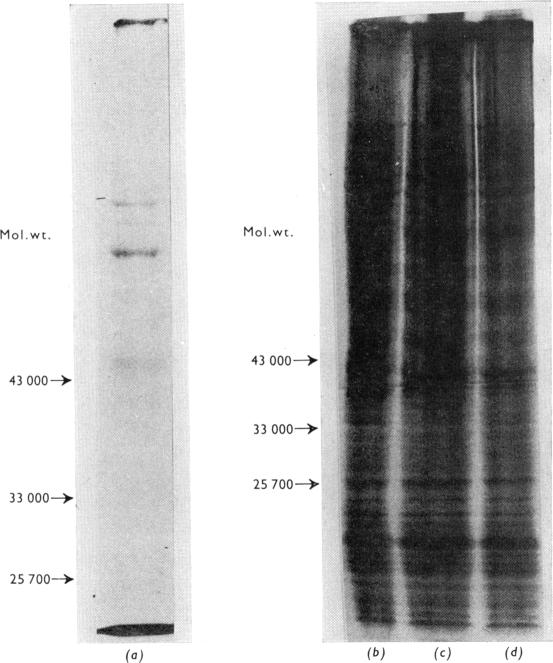
The effect of luteinizing hormone (luteotropin) and cycloheximide on specific protein synthesis in rat testis Leydig cells has been investigated. Proteins were labelled with either I114C]leucine, [3H]leucine or [35S]methionine during incubation with Leydig-cell suspensions in vitro. Total protein was extracted from the cells and separated by sodium dodecyl sulphate/polyacrylamide-gel electrophoresis. No detectable increase in the synthesis of specific proteins could be observed after incubation of Leydig cells with luteinizing hormone for up to 1 h. However, after a 2h incubation period, an increase in [35S]methionine incorporation was observed in a protein with an apparent mol.wt. of 21000 (referred to as 'protein 21"). When, after labelling of this protein with [35S]-methionine, Leydig cells were incubated for another 30min with cycloheximide, no decrease in radioactivity of this protein band was observed, indicating that it does not have a short half-life. However, another protein band was detected, which after incubation with cycloheximide disappeared rapidly, the reaction following first-order kinetics, with a half-life of about 11 min. This protein, with an apparent mol.wt. of 33000 (referred to as "protein 33"), was found to be located in the particulate fraction of the Leydig cell, and could not be demonstrated in other rat testis-cell types or blood cells. No effect of luteinizing hormone on molecular weight, subcellular localization or half-life of protein 33 was observed. A possible role for protein 33 and protein 21 in the mechanism of action of luteinizing hormone on testosterone production of Leydig cells is discussed.
研究了促黄体生成素(促黄体素)和放线菌酮对大鼠睾丸间质细胞中特定蛋白质合成的影响。在体外与间质细胞悬液孵育期间,用[¹⁴C]亮氨酸、[³H]亮氨酸或[³⁵S]甲硫氨酸标记蛋白质。从细胞中提取总蛋白,并通过十二烷基硫酸钠/聚丙烯酰胺凝胶电泳进行分离。将间质细胞与促黄体生成素孵育长达1小时后,未观察到特定蛋白质合成有可检测到的增加。然而,在孵育2小时后,观察到一种表观分子量为21000的蛋白质(称为“蛋白质21”)中[³⁵S]甲硫氨酸掺入量增加。在用[³⁵S]甲硫氨酸标记该蛋白质后,若将间质细胞再与放线菌酮孵育30分钟,未观察到该蛋白带的放射性降低,这表明它没有短半衰期。然而,检测到另一条蛋白带,与放线菌酮孵育后其迅速消失,反应遵循一级动力学,半衰期约为11分钟。这种表观分子量为33000的蛋白质(称为“蛋白质33”)位于间质细胞的颗粒部分,在其他大鼠睾丸细胞类型或血细胞中未检测到。未观察到促黄体生成素对蛋白质33的分子量、亚细胞定位或半衰期有影响。讨论了蛋白质33和蛋白质21在促黄体生成素对间质细胞睾酮产生的作用机制中的可能作用。