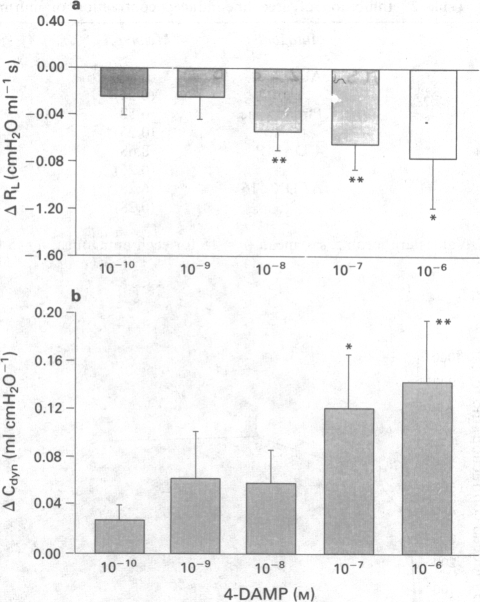
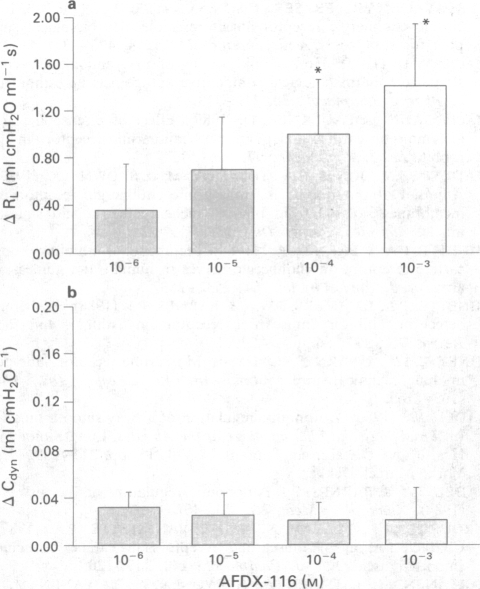
The effects of muscarinic receptor antagonists considered to be selective for M1 receptors (pirenzepine; PZ), M2 receptors (AFDX-116), and for M3 receptors (4-diphenyl acetoxy N-methyl-piperidine (4-DAMP)) were used to investigate the existence of muscarinic receptors subtypes in murine airways. Atropine was used as a nonselective antagonist. The effects of these antagonists were studied upon tracheal contractions induced either by EFS (electric field stimulation) or by application of an exogenous cholinoceptor agonist (arecoline). 2. The muscarinic receptor antagonists tested inhibited arecoline-induced tracheal contractions with the following rank order of potency: 4-DAMP = atropine > pirenzepine = AFDX-116. The rank order of potency of the muscarinic antagonists used in inhibiting EFS-induced tracheal contractions was: 4-DAMP = atropine > PZ > AFDX-116. The pA2 values for these antagonists were similar when compared to the pA2 values determined in guinea-pig and bovine airway smooth muscle. 3. In addition to in vitro studies, the effects of inhalation of the different muscarinic antagonists on lung function parameters in vivo were investigated. Inhalation of 4-DAMP induced a decrease in airway resistance and an increase in lung compliance. In contrast, inhalation of AFDX-116 induced an increase in airway resistance and almost no change in lung compliance. Apart from some minor effects of atropine on airway resistance, atropine, PZ, and pilocarpine failed to induce changes in lung mechanics as determined by in vivo lung function measurements. 4. The results provide evidence for the existence of M3 receptors on murine tracheae that are involved in the contraction of tracheal smooth muscle. This is in agreement with other animal species such as the guinea-pig and bovine. In vivo experiments also demonstrated that in the mouse, M3 receptors play an important role in bronchial smooth muscle contraction and thus in bronchoconstriction. Interestingly we have also demonstrated that M2 receptors can play a role in bronchodilatation. Inhalation of an M2 receptor antagonist induced an increase in airway resistance whereas inhalation of an M3 receptor antagonist induced a decrease in airway resistance. It is therefore likely that an M3/M2 receptor balance plays an important role in the regulation of airway function.