Laugwitz K L, Allgeier A, Offermanns S, Spicher K, Van Sande J, Dumont J E, Schultz G
Institut für Pharmakologie, Freie Universität Berlin, Germany.
Proc Natl Acad Sci U S A. 1996 Jan 9;93(1):116-20. doi: 10.1073/pnas.93.1.116.
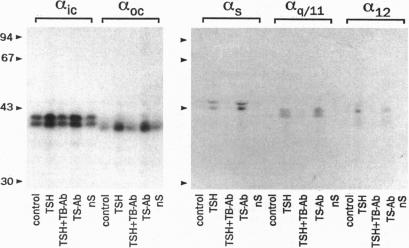
Thyrotropin is the primary hormone that, via one heptahelical receptor, regulates thyroid cell functions such as secretion, specific gene expression, and growth. In human thyroid, thyrotropin receptor activation leads to stimulation of the adenylyl cyclase and phospholipase C cascades. However, the G proteins involved in thyrotropin receptor action have been only partially defined. In membranes of human thyroid gland, we immunologically identified alpha subunits of the G proteins Gs short, Gs long, Gi1, Gi2, Gi3, G(o) (Go2 and another form of Go, presumably Go1), Gq, G11, G12, and G13. Activation of the thyrotropin (TSH) receptor by bovine TSH led to increased incorporation of the photoreactive GTP analogue [alpha-32P]GTP azidoanilide into immunoprecipitated alpha subunits of all G proteins detected in thyroid membranes. This effect was receptor-dependent and not due to direct G protein stimulation because it was mimicked by TSH receptor-stimulating antibodies of patients suffering from Grave disease and was abolished by a receptor-blocking antiserum from a patient with autoimmune hypothyroidism. The TSH-induced activation of individual G proteins occurred with EC50 values of 5-50 milliunits/ml, indicating that the activated TSH receptor coupled with similar potency to different G proteins. When human thyroid slices were pretreated with pertussis toxin, the TSH receptor-mediated accumulation of cAMP increased by approximately 35% with TSH at 1 milliunits/ml, indicating that the TSH receptor coupled to Gs and G(i). Taken together, these findings show that, at least in human thyroid membranes, in which the protein is expressed at its physiological levels, the TSH receptor resembles a naturally occurring example of a general G protein-activating receptor.
促甲状腺激素是通过一个七螺旋受体调节甲状腺细胞功能(如分泌、特定基因表达和生长)的主要激素。在人类甲状腺中,促甲状腺激素受体激活会导致腺苷酸环化酶和磷脂酶C级联反应的刺激。然而,参与促甲状腺激素受体作用的G蛋白仅得到部分确定。在人类甲状腺膜中,我们通过免疫方法鉴定出了G蛋白Gs短亚型、Gs长亚型、Gi1、Gi2、Gi3、G(o)(Go2和另一种形式的Go,可能是Go1)、Gq、G11、G12和G13的α亚基。牛促甲状腺激素激活促甲状腺激素(TSH)受体导致光反应性GTP类似物[α-32P]GTP叠氮苯胺掺入甲状腺膜中检测到的所有G蛋白的免疫沉淀α亚基中增加。这种效应是受体依赖性的,并非由于直接刺激G蛋白,因为患有格雷夫斯病患者的促甲状腺激素受体刺激抗体可模拟这种效应,而来自自身免疫性甲状腺功能减退患者的受体阻断抗血清可消除这种效应。促甲状腺激素诱导的单个G蛋白激活的EC50值为5 - 50毫单位/毫升,表明激活的促甲状腺激素受体以相似的效力与不同的G蛋白偶联。当用人甲状腺切片用百日咳毒素预处理时,1毫单位/毫升的促甲状腺激素使促甲状腺激素受体介导的环磷酸腺苷积累增加约35%,表明促甲状腺激素受体与Gs和G(i)偶联。综上所述,这些发现表明,至少在人类甲状腺膜中,该蛋白以其生理水平表达时,促甲状腺激素受体类似于一种天然存在的通用G蛋白激活受体的例子。