Yamada T, Horiuchi M, Dzau V J
Falk Cardiovascular Research Center, Stanford University School of Medicine, CA 94305-5246, USA.
Proc Natl Acad Sci U S A. 1996 Jan 9;93(1):156-60. doi: 10.1073/pnas.93.1.156.
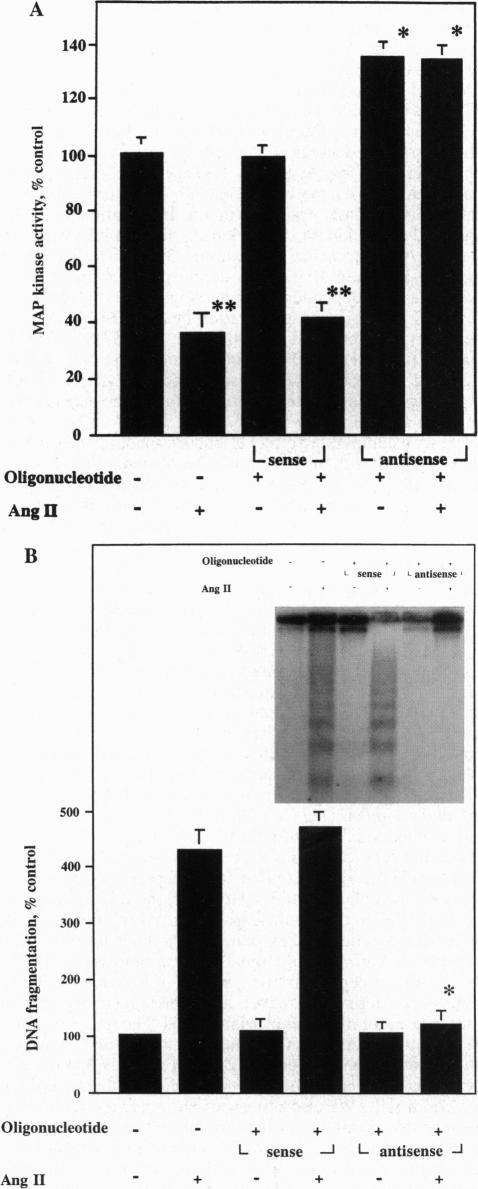
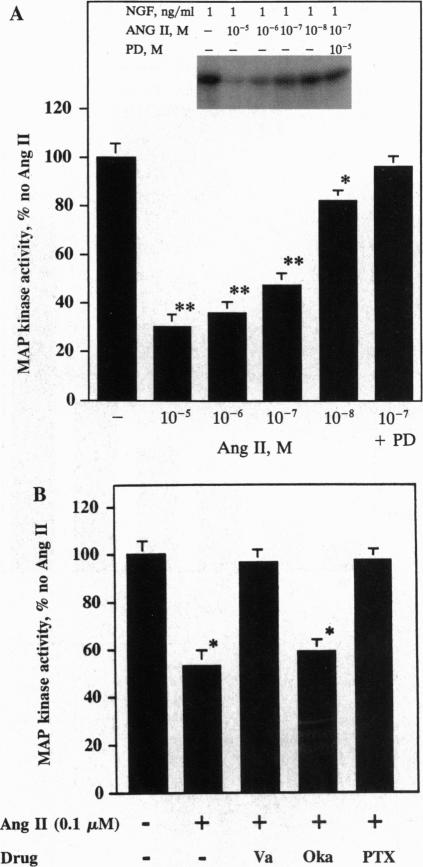
The function of the recently discovered angiotensin II type 2 (AT2) receptor remains elusive. This receptor is expressed abundantly in fetus, but scantily in adult tissues except brain, adrenal medulla, and atretic ovary. In this study, we demonstrated that this receptor mediates programmed cell death (apoptosis). We observed this effect in PC12W cells (rat pheochromocytoma cell line) and R3T3 cells (mouse fibroblast cell line), which express abundant AT2 receptor but not AT1 receptor. The cellular mechanism appears to involve the dephosphorylation of mitogen-activated protein kinase (MAP kinase). Vanadate, a protein-tyrosine-phosphatase inhibitor, attenuated the dephosphorylation of MAP kinases by the AT2 receptor and restored the apoptotic changes. Antisense oligonucleotide to MAP kinase phosphatase 1 inhibited the AT2 receptor-mediated MAP kinase dephosphorylation and blocked the AT2 receptor-mediated apoptosis. These results suggest that protein-tyrosine-phosphatase, including MAP kinase phosphatase 1 activated by the AT2 receptor, is involved in apoptosis. We hypothesize that this apoptotic function of the AT2 receptor may play an important role in developmental biology and pathophysiology.
最近发现的血管紧张素II 2型(AT2)受体的功能仍不清楚。该受体在胎儿中大量表达,但在成体组织中表达较少,除了脑、肾上腺髓质和闭锁卵巢。在本研究中,我们证明该受体介导程序性细胞死亡(凋亡)。我们在PC12W细胞(大鼠嗜铬细胞瘤细胞系)和R3T3细胞(小鼠成纤维细胞系)中观察到这种效应,这两种细胞系表达丰富的AT2受体但不表达AT1受体。细胞机制似乎涉及丝裂原活化蛋白激酶(MAP激酶)的去磷酸化。钒酸盐是一种蛋白酪氨酸磷酸酶抑制剂,它减弱了AT2受体介导的MAP激酶去磷酸化并恢复了凋亡变化。针对MAP激酶磷酸酶1的反义寡核苷酸抑制了AT2受体介导的MAP激酶去磷酸化并阻断了AT2受体介导的凋亡。这些结果表明,包括由AT2受体激活的MAP激酶磷酸酶1在内的蛋白酪氨酸磷酸酶参与了凋亡。我们推测AT2受体的这种凋亡功能可能在发育生物学和病理生理学中起重要作用。